
Russell Finex · Vibrasonic® Deblinding
Ultrasonic Sieving & Mesh Deblinding
Keep fine mesh working when difficult powders block the screen and slow production.
Carolina Material Technologies helps you evaluate Russell Finex ultrasonic deblinding for new screening equipment and compatible existing sieves. Start with your material, mesh, and the performance you need to improve.
Recognize the bottleneck
Is your screen losing effective screening area?
Fine particles can coat the mesh, while particles close to the aperture size can lodge in the openings. As more openings become obstructed, less area remains available for material to pass through.
Common signs worth investigating include:
- Throughput falls as a batch or production run progresses.
- Operators stop frequently to clear or clean the mesh.
- Usable product leaves with the retained oversize.
- A finer mesh meets the size requirement but struggles to maintain the required rate.
These symptoms can have several causes. Feed distribution, moisture, mesh condition, and machine settings should be reviewed alongside deblinding.

High-frequency vibration at the mesh
How ultrasonic sieving works
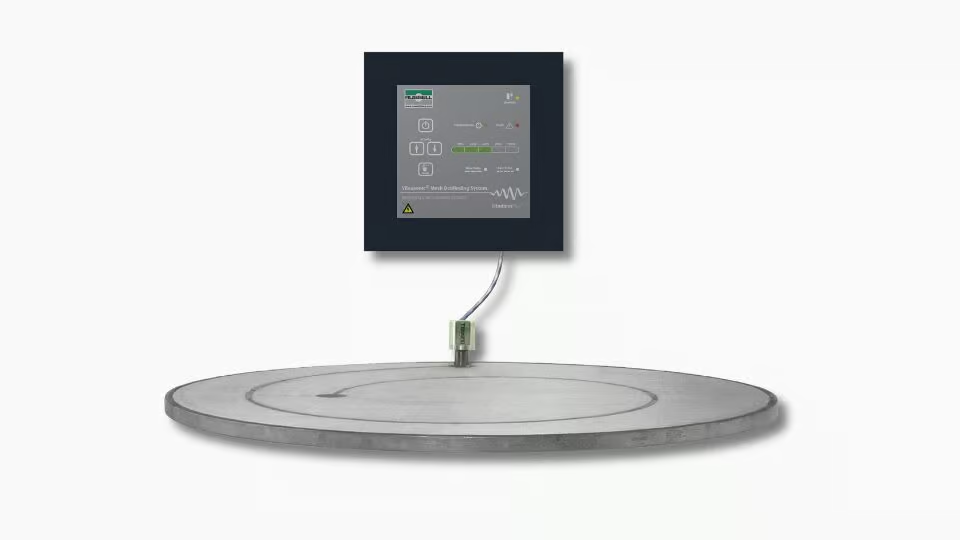
The Russell Vibrasonic® Deblinding System introduces high-frequency vibration to a compatible screen mesh. It works alongside the sieve's main vibration to help prevent particles from sticking to or blocking the screen openings.
01 · Control
Generate the Signal
The ultrasonic control unit supplies the signal that drives the system. Available operating adjustments depend on the selected equipment.
02 · Transfer
Excite the Mesh
A transducer converts the electrical signal into mechanical vibration and transfers that energy into the specially prepared screen assembly.
03 · Screen
Maintain Open Apertures
Ultrasonic activity helps resist particle buildup while the sieve transports material across the screen and separates it through the selected openings.
Equipment demonstration
See ultrasonic deblinding in action
Use the demonstration to explore how ultrasonic assistance relates to powder movement and mesh performance, then review the requirements of your own application.
Watch the deblinding video on YouTube →Evaluate the improvement that matters
Support more consistent fine-powder screening
Where mesh blinding is the limiting factor, ultrasonic assistance can offer several operating benefits. Results depend on the material and complete screening arrangement.
Maintain Screening Rate
Keeping more apertures available can help reduce the decline in throughput caused by progressive mesh blockage.
Evaluate Finer Separations
Ultrasonic assistance can make a finer mesh practical for some difficult powders. The target cut and required rate should be evaluated together.
Reduce Cleaning Interruptions
Less buildup can reduce the need to stop and manually clear the mesh, while limiting repeated handling of delicate screens.
Select the complete screening arrangement
For new equipment or an existing sieve
Ultrasonic deblinding can be evaluated during new machine selection or as an upgrade to compatible equipment. An existing machine needs a compatibility review before a retrofit is specified.
New Check Screeners
Specify mesh, ultrasonic components, and machine configuration together for oversize-removal applications.
Explore Check Screeners →New Grading Sieves
Evaluate which grading cuts need deblinding assistance and whether the proposed deck arrangement can accommodate it.
Explore Grading Sieves →Existing Equipment
Provide the manufacturer, model, screen diameter, mesh specification, and photographs. Screen construction, clearances, and operating conditions affect compatibility.
Request a Retrofit Review →Application review
Help us understand your mesh-blinding problem
Share what you are screening, when performance changes, and the result you need. These details help CMT and Russell Finex assess the next step.
| Information | Details to provide |
|---|---|
| Material behavior | Product name, particle-size distribution, bulk density, moisture, temperature, and tendency to stick or agglomerate. |
| Mesh specification | Aperture in microns, mesh count and wire diameter if known, screen material, and current screen construction. |
| Current equipment | Manufacturer, model, screen diameter, number of decks, existing deblinding method, and photos of the installation. |
| Performance problem | Starting and sustained feed rates, time before blinding appears, cleaning frequency, and product lost with oversize. |
| Required result | Target throughput, separation specification, acceptable yield, and desired operating time between interruptions. |
| Process requirements | Cleaning method, contact materials, containment, relevant area classification, power supply, and documentation needs. |
Common questions
Ultrasonic sieving FAQs
Is ultrasonic deblinding a separate screening machine?
It is a system that works with compatible sieving equipment and a suitable screen assembly. The sieve handles material movement and discharge; ultrasonic energy acts at the mesh to help resist blinding.
Can ultrasonic deblinding be fitted to an existing sieve?
Potentially. Existing equipment needs a review of its screen construction, dimensions, available space, and operating requirements. CMT can help gather the information for Russell Finex to evaluate a suitable retrofit.
Will it increase throughput on every powder?
No. The improvement depends on whether mesh blinding limits the process. Poor feeding, insufficient screening area, moisture, or another restriction may require a different solution. Representative testing helps establish the likely benefit.
Does ultrasonic sieving change the mesh opening?
The selected aperture remains the nominal size cut. Ultrasonic assistance helps keep openings available for screening; it does not replace correct mesh selection or verification of the final product.
Does it replace routine cleaning and screen inspection?
No. Ultrasonic deblinding can reduce interruptions caused by buildup, but routine cleaning, sanitation, and inspection for damage or wear remain necessary.
How does it compare with balls, discs, or brushes?
Mechanical systems physically act on the screen to help clear particles. Ultrasonic systems transmit high-frequency vibration into a compatible mesh assembly. Selection depends on the material, aperture, screen design, and required performance.
Should I choose ultrasonic deblinding or a different screener?
Review the whole application. A different mesh, feed arrangement, machine setting, or separator design may be more appropriate. Ultrasonic deblinding is one option to evaluate against the required throughput and separation quality.
Explore related screening equipment
Check Screeners
Remove oversize contamination from powders and suitable liquid products.
View Check Screeners →Grading Sieves
Separate material into defined particle-size fractions using vibratory separators.
View Grading Sieves →Russell Finex Equipment
Explore screening, separation, and liquid filtration options for your process.
View the Equipment Range →Get more from your screening process
Tell us about your powder, current mesh, and operating challenge. We will help you evaluate whether ultrasonic deblinding is a suitable next step.