
Russell Finex · Check Screening
Industrial Check Screeners
Remove oversize contamination from powders and liquids with screening equipment selected for your material and process.
From the Russell Compact Sieve® to bag-dump and conveying configurations, Carolina Material Technologies helps you evaluate the right screening arrangement, mesh, and process connections.
Product quality starts with the separation
What is industrial check screening?
Check screening, also called safety screening, passes material through a selected screen aperture to remove oversize particles or contamination. It can be installed at ingredient intake, between process steps, or before packing.
01 · Feed
Introduce the material
Deliver powder or liquid to the screener at a controlled rate. Consistent feeding helps use the available screening area effectively.
02 · Screen
Separate at the mesh
In a vibratory sieve, vibration assists material passage through the mesh. Particles retained by the selected aperture stay above the screen.
03 · Discharge
Direct each stream
Screened product continues to the next process. Retained oversize is removed through the arrangement selected for batch or continuous operation.
The core check-screening solution
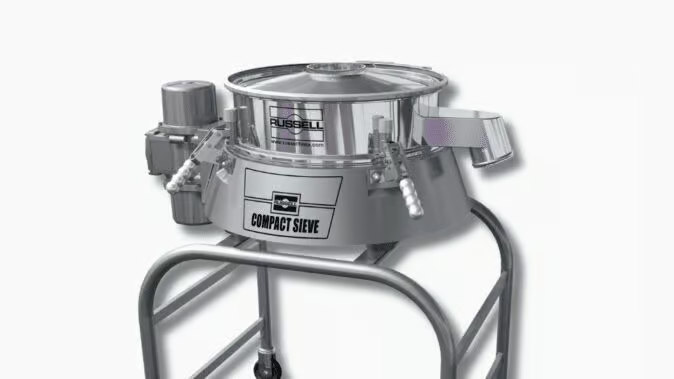
Russell Compact Sieve®
A compact vibratory sieve for screening powders and liquid slurries where installation height, cleaning access, and product quality matter.
- Limited headroom: a low-profile layout helps fit screening into existing process lines.
- Accessible contact parts: tool-free disassembly supports cleaning, inspection, and screen changes.
- Application-specific mesh: select the aperture around the product and separation requirement.
- Flexible configuration: evaluate connections, finishes, and deblinding options around the installation.
Throughput depends on the material, aperture, feed conditions, and machine configuration. Material testing can help establish the appropriate selection.

Equipment demonstration
See the screening equipment in action
Use the demonstration alongside your application review to discuss material feed, screen access, and discharge arrangement.
Watch the supplied Russell Finex video on YouTube →Match the equipment to the installation
Check screeners for different process requirements
Consider how the material arrives, the required containment, and the next process step. These configurations address different screening duties.

Containment & changeovers
Compact Airlock Sieve™
Pneumatic clamping provides a repeatable seal and simplifies assembly. Consider for applications with demanding containment and cleaning requirements.

Hand-fed bags
Compact 3in1 Sieve™
Combines bag tipping, screening, and magnetic separation. The hood connects to an appropriately selected dust-extraction system.
Explore bag dump stations →
Vacuum conveying
Compact Airswept Sieve™
Combines check screening with vacuum conveying. Review conveying conditions and line connections as part of the selection.

Integrated material transfer
Compact Self-Loading Sieve™
A standalone arrangement for loading, screening, and discharging material. Consider where an integrated transfer and screening package suits the process.

Small batches
Russell Mini Sifter™
A compact option for check screening smaller batches of powders or liquids.

Rotary screening
Russell Turbo Sifter™
A rotary option for powder check screening and de-agglomeration. Its paddle action differs from the vibration used by the Compact Sieve.

Fine & heavy powders
Russell Compact G-Max™
A twin-motor check screener designed for fine and heavy powders. Include it in the application review when material behavior calls for a different screening configuration.
Ask about the right sifter for your material →Solve the screening bottleneck
Options that address common operating problems

Blinded or Blocked Mesh
Evaluate Vibrasonic® ultrasonic deblinding when fine or difficult powders reduce open screening area. Mesh selection and feed conditions should be reviewed at the same time.

Good Product in the Oversize
A Russell Gated Outlet™ controls oversize discharge, helping keep material on the mesh longer when premature discharge causes product loss.

Frequent Product Changes
Review clamp access, screen handling, contact finishes, and cleaning procedures to make the selected arrangement practical for daily operation.
Application and sizing guide
What we need to select your screener
The right machine is determined by more than inlet size or screen diameter. Share the following information to help CMT and Russell Finex evaluate the application.
| Selection factor | Details to provide |
|---|---|
| Material | Product name, powder or liquid, bulk density or viscosity, temperature, and any tendency to stick or agglomerate. |
| Separation requirement | Target aperture in microns, existing mesh specification, oversize characteristics, and acceptable product quality. |
| Production rate | Normal and peak throughput in lb/hr or gal/min, batch size, and operating schedule. |
| Feed and discharge | Gravity, feeder, bag dump, or conveying feed; downstream connection; and how retained oversize will be handled. |
| Installation space | Available headroom, footprint, connection heights, and access for cleaning and screen removal. |
| Process requirements | Contact materials, sanitation, containment, relevant area classification, utilities, and documentation needs. |
Connect screening to your process
From ingredient intake to finished product
Evaluate screening for food ingredients, chemical powders, pigments, coatings, pharmaceutical excipients, and suitable liquid slurries. CMT helps consider the equipment before and after the sieve.
Bagged Ingredients
Review bag handling, extraction, and the screen feed arrangement together.
Bag dump stations →Process Integration
Coordinate feed control, conveying, mixing, and discharge connections.
Bulk material handling systems →Other Separation Needs
Explore grading, ultrasonic deblinding, and liquid filtration for related process requirements.
Russell Finex equipment range →Common questions
Check screener FAQs
Are a sifter, sieve, and screener the same thing?
The terms often overlap in industrial processing. The important distinction is the duty: removing oversize, producing multiple size grades, or separating solids from liquid. The mechanism and configuration should match that duty.
Can the Russell Compact Sieve screen powders and liquids?
Yes. The Compact Sieve is used for powder and liquid-slurry check screening. Each application still needs an appropriate mesh, material-compatible construction, feed arrangement, and capacity assessment.
How do I choose the mesh size?
Start with the required product specification and what must be removed. Mesh count alone does not uniquely define the opening because wire diameter also matters. Provide the aperture in microns or the full screen specification when possible.
Will a screener remove all foreign material?
No. A screen separates according to its openings; contamination that passes through those openings may remain in the product. Magnetic separation or metal detection may be appropriate as additional controls. Screen integrity and inspection are also important.
Is the Compact Airlock Sieve a rotary airlock valve?
No. The Compact Airlock Sieve is a screening machine with a pneumatic clamping system. Its name does not mean it performs the pressure-isolation or metering function of a rotary airlock valve.
Can one screener handle several products?
Potentially. Review each product's screening requirement, throughput, cleaning procedure, and cross-contamination considerations. Interchangeable meshes and accessible contact parts can support product changes.
Can you confirm throughput before purchase?
Throughput should be evaluated using the material and required separation. Ask CMT about coordinating a Russell Finex application review and available testing options rather than relying on a capacity figure from an unrelated product.
Let’s review your screening application
Tell us what you process, what you need to remove, and the throughput you want to achieve. We will help you evaluate the equipment and configuration.