
Portable IBC Systems for Dust-Tight, Mass-Flow Discharge
Store, move and discharge difficult powders from one reusable container system. SoliBin™ portable IBCs use lifting cone-valve technology to promote consistent flow, reduce segregation and limit dust exposure from filling through downstream processing.
Turn the container into an active part of the process
Conventional bins can store material, but they do not necessarily solve poor flow, dusting, blend segregation or repeated transfers. A properly configured SoliBin™ system carries the batch through storage, movement and discharge while the lifting cone valve actively promotes flow at the point of use.
Bridging & Rat-Holing
The internal cone lifts into the material and can vibrate or pulse to help restart flow when powders compact during storage or transport.
Segregation & Degradation
Annular discharge supports a mass-flow pattern with less relative particle movement, helping preserve blend uniformity and fragile product quality.
Dust & Exposure
Docking seals the IBC to the discharge station so material can transfer into the process with reduced operator contact and fewer open handling steps.
Changeover & Transfers
Dedicated or campaign-based containers can reduce intermediate transfers, simplify batch identification and support faster product changes.
Three coordinated elements—not just a tote
The performance comes from matching the container, docking station and control method to the material and downstream process.
Portable IBC Container
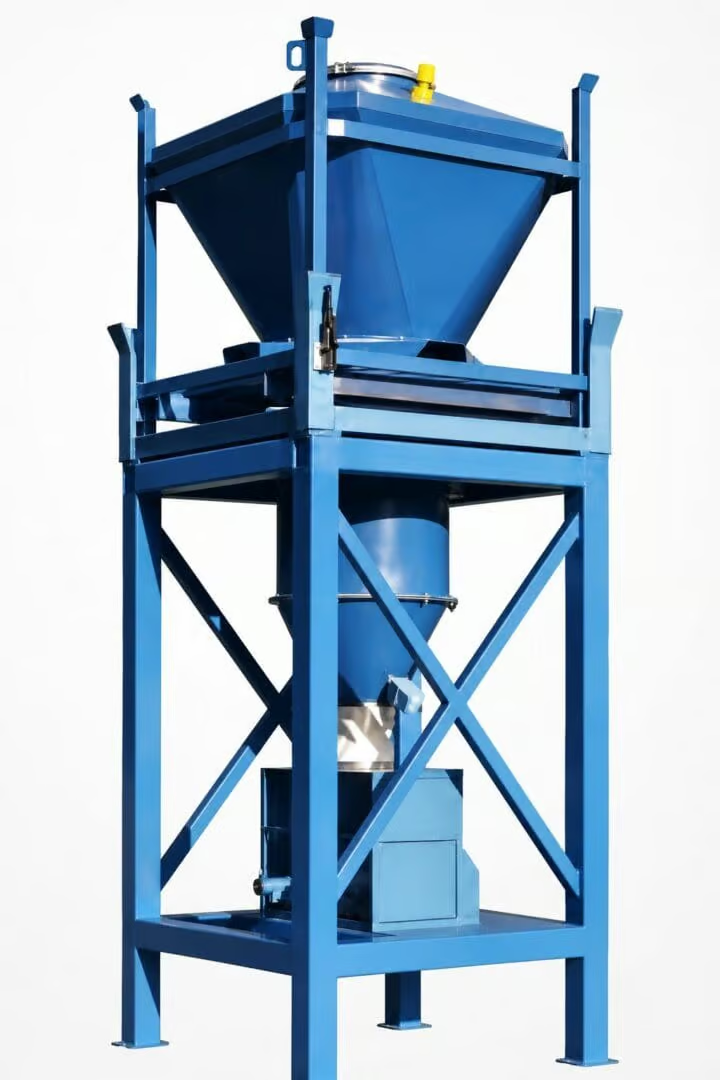
A reusable square container stores and transports the batch. The internal inverted cone valve remains seated during storage and movement.
- Polyethylene, mild steel or stainless steel
- Forklift, pallet, trolley or crane handling
- Stackable configurations available
Discharge Station
The station locates the bin, seals the interface and pneumatically raises the cone valve to create the discharge annulus.
- Low-profile and elevated arrangements
- Vibration and cone pulsing when required
- Fixed or variable discharge strategies
Controls & Process Interface
Controls coordinate docking, cone movement, vibration and downstream equipment for manual, batch or automated operation.
- Weighing and batch controls
- Feeders, gates or conveyors below the station
- Recipe, interlock and level-control integration
Dock, seal and activate the cone valve
The container is positioned on the station, automatically located by the corner guides and sealed at the outlet. The actuator then lifts the internal cone to open an annular flow path. Vibration or pulsing can be added for materials that need extra activation.

Move the filled container by forklift, pallet device or crane and lower it into the station guides.
The container is positively located and the outlet interface is sealed before discharge begins.
The probe raises the cone valve. Vibration or controlled pulsing promotes smooth discharge as the process demands.
Why mass flow matters for powders and blends
In a mass-flow pattern, the material moves through the container as a coordinated body and the top surface largely retains its shape. This supports first-in, first-out discharge and helps reduce the particle rearrangement that can separate a blend.
- More consistent blend delivery to the downstream process
- Reduced stagnant zones and residual product
- Better control of cohesive or compacted material
- Potentially less product degradation than uncontrolled funnel flow
Final flow performance depends on the specific powder, bulk density, moisture, particle shape, storage time and operating conditions. Material testing is recommended for challenging applications.

Match the bin construction and handling method to the process
Container selection is driven by material compatibility, sanitation, batch size, transportation method, stacking needs and the amount of changeover required.

Lightweight Polymer IBCs
Useful where corrosion resistance, lower container weight or a nonmetallic product-contact surface is preferred.

Stainless or Mild Steel
Rugged containers for demanding industrial duty, high-density products and applications requiring special finishes or cleanability.

Special Inlets, Frames & Mobility
Custom tops, covers, frames, fork channels, caster bases and handling features can adapt the IBC to plant logistics.

Stackable Container Fleets
Reusable IBC fleets can organize work-in-process inventory, improve batch control and reduce disposable packaging waste.


Activate flow without opening the container to the room
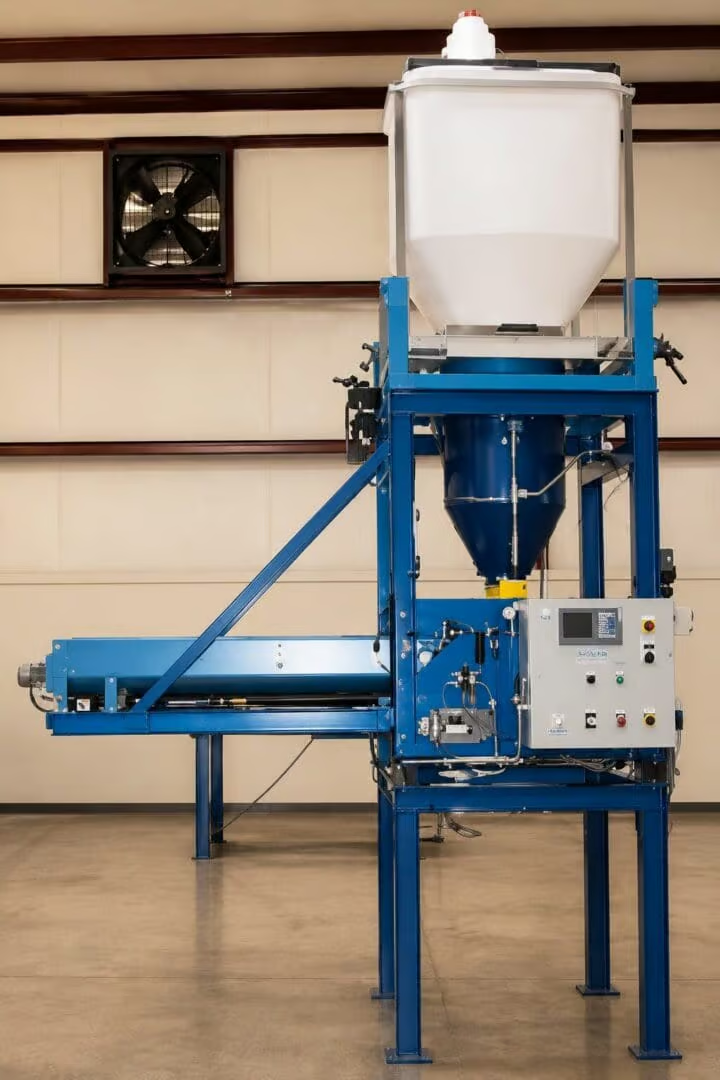
The discharge station is the active part of the system. Its pneumatic actuator engages the internal cone valve, lifts it to create flow and can add vibration or repeated pulsing for difficult materials.
- Automatic container location and sealed docking
- Flow can be stopped and a partly filled IBC removed
- Low-level stations or elevated frames for downstream equipment
- Optional external vibration for especially difficult products
- Integration with feeders, slide gates, weigh systems and conveyors
From simple docking stations to integrated batch systems
The station can discharge directly into a process or be paired with secondary equipment for controlled feeding, conveying, weighing or batching.

Designed for powders where handling quality matters
Portable IBC systems are especially useful when a material is cohesive, valuable, dusty, contamination-sensitive, prone to segregation or processed in identifiable batches.
Food & Ingredients
Powders, blends, spices, cocoa, starches and specialty ingredients where dust control and batch integrity are priorities.
Chemicals & Plastics
Additives, resins, pigments and formulations that benefit from contained movement, controlled dosing and reduced cross-contamination.
Minerals & Metal Powders
Dense, abrasive or segregation-sensitive materials requiring rugged containers, traceable batches and consistent feed to downstream equipment.
Batching & Process Transfer
Work-in-process storage, mixer charging, press feeding, packaging feed and containerized manufacturing workflows.
Standard platforms with application-specific engineering
The items below are useful starting points. Current availability and final dimensions should be confirmed for each project.
Capacity, dimensions, outlet size, finishes, approvals and options vary by model and application. Confirm all specifications during project review.
Information needed to configure the right IBC system
A portable IBC should be selected around both the material and the process. These inputs help determine capacity, construction, flow-assistance strategy, station height and downstream controls.
| Design Input | Details to Review | Why It Matters |
|---|---|---|
| Material Properties | Name, bulk density, particle size, moisture, cohesiveness, abrasiveness, friability and toxicity. | Determines container construction, cone activation, finishes and whether material testing is advisable. |
| Batch & Capacity | Batch weight, required working volume, number of IBCs, storage duration and production schedule. | Establishes container capacity, fleet size and turnaround requirements. |
| Required Discharge | Fast emptying, controlled batch shots, continuous metering or loss-in-weight/gain-in-weight operation. | Defines the control strategy and whether a feeder, gate or scale should be installed below the station. |
| Plant Handling | Forklift access, crane lifting, mobile trolley, aisle width, stacking, trailer transport and available headroom. | Influences frame design, fork spacing, station height and safe operating layout. |
| Cleaning & Containment | Allergen or color changeover, cross-contamination limits, dust exposure, washdown and product recovery. | Guides container dedication, seals, access, finishes and cleaning equipment. |
| Downstream Equipment | Mixer, press, packaging line, pneumatic conveyor, mechanical conveyor, feeder or process vessel. | Sets discharge elevation, support structure, interlocks and equipment interface. |
Frequently asked questions
Answers to common questions about cone-valve IBCs, discharge stations and system selection.
What is a SoliBin portable IBC system?
A SoliBin system combines a reusable intermediate bulk container, a cone-valve discharge station and controls. The IBC stores and transports the powder; the station docks to the container and lifts its internal cone valve to initiate discharge.
How does the lifting cone valve help difficult powders flow?
The cone lifts upward into the bulk material, displacing product and creating an annular opening around the cone. The station can also vibrate or pulse the cone to keep cohesive or compacted material moving.
Can discharge be stopped before the IBC is empty?
Yes. The cone valve can be lowered back into its seat to stop flow, allowing a partly filled container to be removed when the application and operating procedure permit.
Does a cone-valve IBC reduce powder segregation?
The broad annular opening is designed to encourage mass flow and reduce the selective flow channels associated with rat-holing and funnel flow. Actual segregation performance depends on the blend and operating conditions, so testing may be appropriate for critical products.
What container materials and sizes are available?
Common construction choices include polyethylene, mild steel and stainless steel. Carolina Conveying currently lists common standard capacities of 18, 25, 35, 50 and 70 cubic feet. Custom or alternate configurations may be available and should be confirmed during application review.
Can the IBC discharge directly into a feeder, mixer or conveyor?
Yes. Stations can be elevated or arranged over screw feeders, gates, weigh systems, pneumatic conveying pickups, mechanical conveyors, mixers, packaging lines and other process equipment. The downstream interface should be engineered as part of the complete system.
Planning a portable IBC or containerized powder-handling system?
Send us your material, batch size, flow challenges and downstream process. Carolina Material Technologies can help configure the container, discharge station, flow assistance and system interface for your application.
- Material name and loose bulk density
- Particle size and flow characteristics
- Required batch weight or container volume
- Desired discharge rate and accuracy
- Available headroom and handling method
- Downstream feeder, conveyor or process