
Russell Finex · Particle-Size Classification
Grading Sieves & Vibratory Separators
Separate powders, granules, and suitable wet materials into defined size fractions.
Carolina Material Technologies helps you evaluate Russell Finex grading sieves for removing fines, separating oversize, and recovering the product size range your process needs.
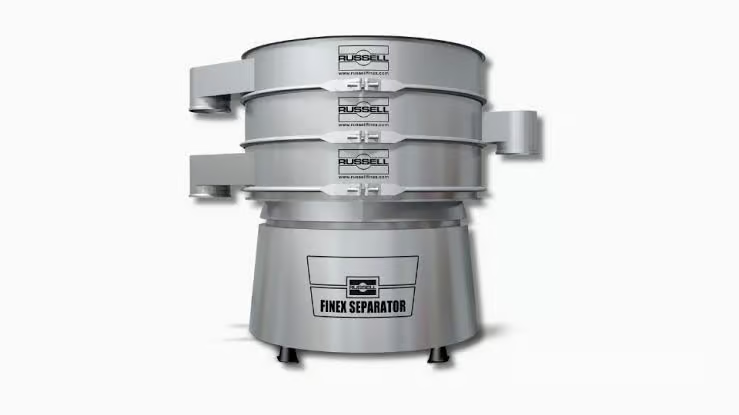
Control the particle-size range
How does a grading sieve work?
A grading sieve separates material using one or more screens with selected apertures. Vibration moves material across each mesh: smaller particles pass through, while retained particles travel toward a separate outlet.
With multiple decks, progressively finer screens create separate product streams. The screen openings and material movement are selected around the fractions you want to collect.
01 · Upper screen
Remove the oversize
The first screen retains material above the upper size cut. Material that passes through continues to the next deck.
02 · Lower screen
Collect the target grade
A finer second screen retains the middle fraction: material that passed the upper screen but does not pass the lower one.
03 · Through the lower mesh
Separate the fines
Particles that pass both screens leave as the fine fraction. This two-screen example produces three separate size streams.
Russell Finex grading equipment
Compare the separator range
Material behavior, separation accuracy, cleaning requirements, and capacity determine which separator to evaluate. These machines provide different approaches to the same core task: controlling particle-size fractions.
Flexible wet & dry grading
Finex Separator™
A vibratory separator with adjustable material movement and rubber suspension. Multiple screen decks allow separation into up to five size fractions.
Evaluate for powder classification, fines removal, and suitable wet separation duties.

Accessible hygienic design
Finex Ultima™
A wet and dry separator with an open stainless-steel frame and rubber suspension. Its accessible design supports cleaning and inspection.
Evaluate where sanitation, maintenance access, and multi-deck grading are priorities.

Challenging materials
Quantum Separator™
A high-vibration separator designed for difficult-to-sieve powders and liquids, including fine, cohesive, or agglomerating materials.
Evaluate where material behavior limits grading performance or production capacity.
Deck count, mesh, machine size, and available options depend on the selected model and application. Capacity should be evaluated with your material and required separation.
Screen decks and product flow
Configure the separation around your product
A multi-deck separator can produce several saleable grades or isolate an on-size product between oversize and fines. Each outlet needs a clear destination, whether that is collection, rework, or another process step.
- Screen apertures: establish the nominal boundaries between collected fractions.
- Material movement: balance residence time and flow across the screening area.
- Discharge arrangement: coordinate each outlet with downstream equipment and available space.

Define the separation objective
Common grading and separation duties
Particle-Size Classification
Divide a feed into specified fractions for different product grades or downstream processing requirements.
Fines & Oversize Removal
Recover the desired middle fraction by separating material above and below the required size range.
Wet Separation & Recovery
Evaluate screening for dewatering or recovering solids from suitable wet feeds. Solids loading and liquid characteristics affect performance.

Applications across process industries
Grading can be evaluated for food ingredients, spices, chemical powders, minerals, ceramics, polymer granules, and suitable pharmaceutical products.
For each application, begin with the feed particle-size distribution, desired fractions, and acceptable amount of misplaced material. Those details help define a meaningful performance target.
Equipment demonstration
See vibratory separation in action
Review the demonstration alongside your application to discuss screen arrangement, material movement, and discharge routing.
Watch the separator video on YouTube →Options for performance and access
Address the details that affect everyday operation
Review option compatibility with the selected separator and material. The same upgrade is not necessarily appropriate for every grading duty.

Screen Deck Lifting
Evaluate lifting assistance for access during screen inspection, cleaning, and replacement. Include overhead clearance and maintenance space in the layout.
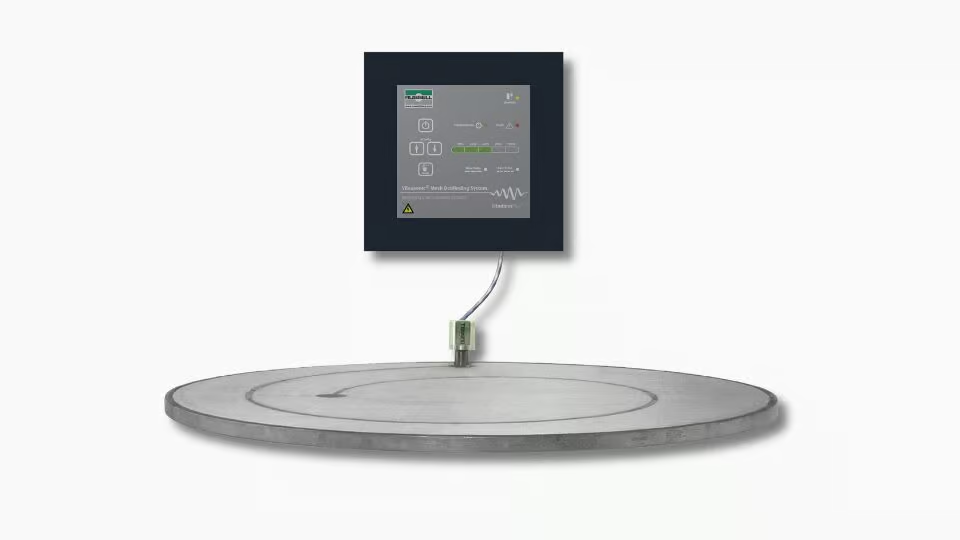
Mesh Deblinding
Ultrasonic or mechanical deblinding may help maintain open screening area on compatible arrangements. Select around the mesh, powder behavior, and separator design.

Gated Outlet Control
Control discharge where material leaves the screen before adequate separation. Evaluate residence time and product loss as part of the application review.
Application and sizing guide
What we need to select your grading sieve
Share the required separation and operating conditions so CMT and Russell Finex can evaluate the screen configuration and equipment.
| Selection factor | Details to provide |
|---|---|
| Feed material | Product name, particle-size distribution, bulk density, moisture, temperature, and tendency to stick or agglomerate. |
| Required fractions | Number of product streams, upper and lower size limits, and whether each stream is product, rework, or waste. |
| Separation quality | Acceptable fines or oversize in each product stream, required yield, and the method used to verify product quality. |
| Capacity | Normal and peak feed rates, batch or continuous operation, and estimated proportion reporting to each outlet. |
| Wet-feed conditions | Liquid viscosity, solids loading, desired solids recovery, and dewatering objectives where applicable. |
| Installation | Available footprint and headroom, feed arrangement, outlet routing, access for screen changes, and cleaning requirements. |
| Construction & utilities | Contact materials, finishes, seals, available power and air, relevant area classification, and documentation requirements. |
Common questions
Grading sieve FAQs
What is the difference between grading sieves and check screeners?
Grading sieves classify material into defined particle-size fractions. Check screeners focus on removing oversize contamination from a product stream. Some machines can perform more than one duty, but the separation objective guides selection.
How many fractions can a separator produce?
A suitable four-screen arrangement can produce up to five fractions. Fewer decks are used when fewer cuts are required. Available configurations depend on the separator, material, and application.
Does adding more decks increase capacity?
Additional grading decks create more size cuts; they do not automatically increase feed capacity. Each deck must handle the material reaching it, and a difficult separation on one deck can limit the overall process.
Can a grading sieve remove fines from granules?
Yes, where the fine particles can be separated through an appropriate screen. Review the size distribution, particle shape, moisture, and whether fines are loose or attached to the granules. Testing may be needed to establish achievable separation.
Can these separators handle wet materials?
Suitable configurations can process wet feeds for grading, dewatering, or solids recovery. Liquid characteristics, solids loading, screen selection, and the desired output determine suitability.
What affects grading accuracy?
Screen aperture and condition, particle shape, feed distribution, bed depth, mesh blinding, and material movement all affect separation. Machine settings need to balance throughput with sufficient opportunity for particles to pass the mesh.
Do all difficult powders need ultrasonic deblinding?
No. The appropriate approach depends on the material, mesh, and separator design. Ultrasonic deblinding, mechanical cleaning, or a different machine configuration may be evaluated. The Quantum Separator, for example, uses a high-vibration design for challenging materials.
Explore related equipment
Check Screeners
Compact Sieves and other configurations for removing oversize contamination.
Explore check screeners →Russell Finex Equipment
View screening, ultrasonic deblinding, liquid filtration, and liquid-solid separation.
View the equipment range →Process Integration
Coordinate separator feeding and multiple discharge streams with the rest of your process.
Explore material handling systems →Define the grade. Find the right separator.
Tell us about your feed material, required size fractions, and production rate. We will help you evaluate a grading solution around your process.