
Screening · Separation · Liquid Filtration
Russell Finex Screening & Filtration Equipment
Protect product quality, improve particle-size consistency, and keep material moving through your process.
Carolina Material Technologies helps you evaluate Russell Finex equipment for powder screening, grading, ultrasonic mesh deblinding, liquid filtration, and liquid-solid separation.

Find the right separation method
What does your process need to separate?
Removing oversize contamination, producing multiple particle-size grades, and filtering a liquid require different approaches. Start with your objective, then select the equipment and configuration around it.
Remove oversize contamination
Check Screeners
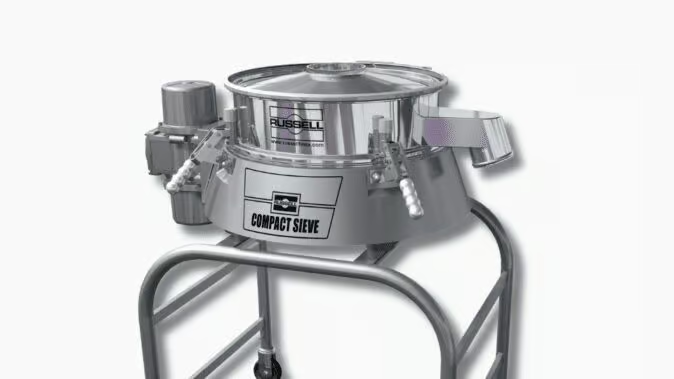
Check-screen powders or liquid slurries to separate oversize material before the next production step. The Russell Compact Sieve® offers a compact arrangement for installations with limited headroom.
Consider for: incoming ingredients, screening before mixing, and final product checks.
Explore Check Screeners →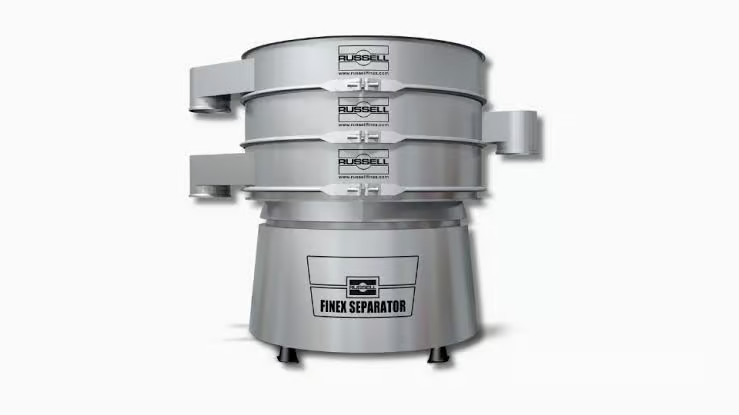
Classify by particle size
Grading Sieves
Grade wet or dry materials into defined size fractions. The Finex Separator™ can use multiple screen decks to separate material into as many as five fractions in one operation.
Consider for: removing fines, separating oversize, and recovering an on-size product.
Explore Grading Sieves →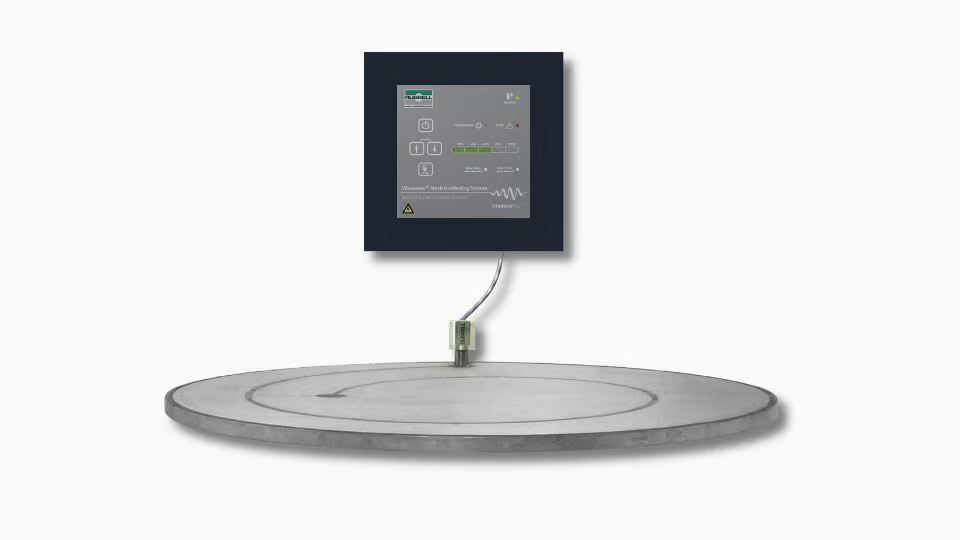
Keep fine mesh working
Ultrasonic Sieving
The Russell Vibrasonic® Deblinding System applies ultrasonic vibration to the screen mesh to help prevent blockage when processing fine or difficult powders.
Consider for: blinded screens, reduced screening rates, and finer separation requirements.
Explore Ultrasonic Sieving →
Filter liquid products
Self-Cleaning Liquid Filters
The Self-Cleaning Russell Eco Filter® removes oversize contamination from liquids and pastes. Its reusable filter element and cleaning mechanism help reduce interruptions associated with element cleaning and replacement.
Consider for: paints, coatings, resins, adhesives, and liquid food products.
Explore Self-Cleaning Liquid Filters →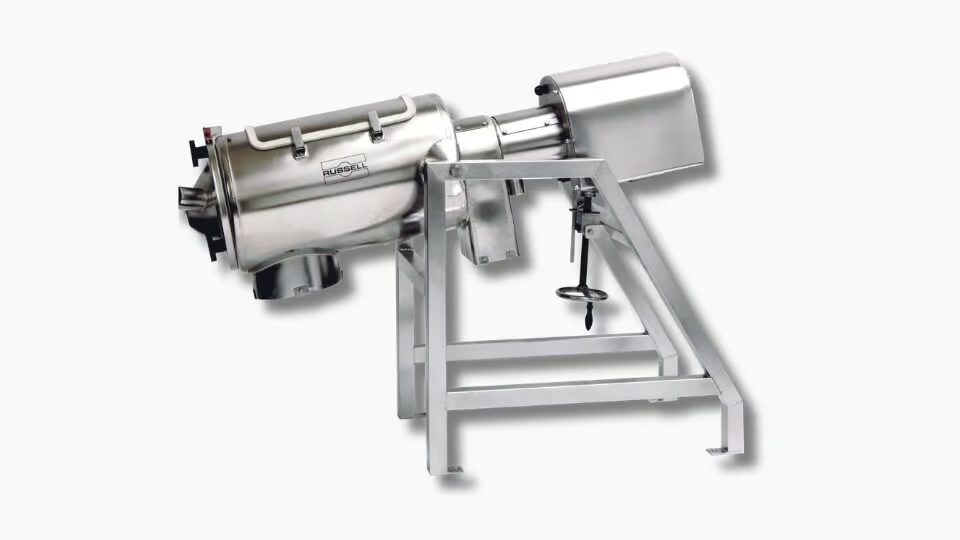
Separate solids from slurries
Liquid-Solid Separators
The Russell Liquid Solid Separator™ continuously separates retained solids from a liquid stream using a rotating paddle assembly and cylindrical screen.
Consider for: product recovery, soft or fibrous solids removal, and process-water applications.
Explore Liquid-Solid Separators →
Screen as bags are emptied
Integrated Bag Dump Screening
The Russell Compact 3in1 Sieve™ brings bag tipping, check screening, and magnetic separation together. Its dust hood connects to a suitable extraction system.
Consider for: hand-fed bagged ingredients entering mixing or conveying processes.
Explore bag dump screening →Applications across process industries
Start with the material and the quality requirement
Particle size, flow behavior, liquid viscosity, and cleaning requirements all influence the right separation approach.
Food & Ingredients
Screen flour, sugar, spices, and ingredient powders, or evaluate filtration for liquid foods. Consider cleaning access, product changes, and where screening fits in the line.
Chemicals & Coatings
Evaluate powder screening and liquid filtration for pigments, powder coatings, resins, and adhesives. Material compatibility and operating conditions guide the configuration.
Pharmaceuticals
Assess screening for powders and excipients with attention to containment, contact materials, surface finish, and the documentation required for the application.
Configure around the process
Address the details that affect daily operation
Feed consistency, oversize discharge, cleaning access, and downstream connections matter as much as the machine itself.
Oversize Discharge Control
A Russell Gated Outlet™ can help retain material on the screen long enough to reduce good-product loss through the oversize outlet. Suitability depends on the material and screening duty.
Containment & Cleaning
Review clamping arrangements, access for screen changes, contact finishes, and dust-extraction connections. Higher-containment configurations can be evaluated where required.
Liquid Filter Options
Evaluate heating jackets, high-temperature configurations, filter elements, and discharge automation around the liquid, process conditions, and cleaning needs.
Connect separation to the rest of your line
CMT can help review how screening and filtration fit with unloading, feeding, conveying, mixing, and dust collection. Inlet height, discharge routing, access, and available space are part of that discussion.
Explore bulk material handling systems →Application support from CMT
Help us understand what needs to improve
Whether you are selecting new equipment or addressing a separation bottleneck, start with the material and the result you need. CMT can help develop the equipment inquiry and review the process connections.
For challenging applications, ask about Russell Finex material testing to evaluate separation quality and throughput before final equipment selection.
Material Product name, powder or liquid, and relevant handling characteristics.
Separation Target mesh or micron size, contamination, or required size fractions.
Capacity Required throughput and whether operation is batch or continuous.
Conditions Temperature, viscosity or bulk density, and solids loading as applicable.
Installation Feed method, inlet and outlet heights, space, and downstream equipment.
Process Requirements Cleaning, containment, contact materials, and relevant area classification.
Common questions
Russell Finex equipment FAQs
What is the difference between check screening and grading?
Check screening removes oversize material from a product stream. Grading separates material into defined particle-size ranges, often using several screen decks. The required result determines which approach to evaluate.
When should ultrasonic deblinding be considered?
Consider ultrasonic deblinding when fine or difficult powders block the screen mesh and reduce effective screening area. Material trials and a review of feed rate, mesh, and machine settings help determine whether it is suitable.
How does a self-cleaning filter differ from a liquid-solid separator?
A self-cleaning filter removes oversize contamination through a reusable filter element that is cleaned during operation. A liquid-solid separator uses a screen and rotating assembly to separate and discharge retained solids from a slurry. Solids concentration, particle characteristics, and the desired liquid and solids outputs guide selection.
Can screening be integrated with bag unloading or conveying?
Yes. Integrated bag-dump screening and conveying-related configurations can be evaluated. The arrangement depends on the feed method, available headroom, pressure or vacuum conditions, containment requirements, and downstream process.
What determines the capacity of a screener or filter?
Capacity depends on the material, aperture size, feed conditions, and required separation. Powder flow behavior, liquid viscosity, solids loading, and mesh blinding can all affect performance. A capacity achieved with one product should not be treated as a guarantee for another.
Find the right fit for your material
Tell us what you process, the separation you need, and the production challenge you are working to solve. We will help you evaluate the next step.