
Mesh to Micron Conversion Chart
Convert U.S. mesh sizes to microns, millimeters and inches with this quick reference for powders, bulk solids, screening, sifting, conveying, feeding and filtration applications.
Mesh → Micron Converter
Select a mesh number to view its nominal sieve opening.
Mesh Size Compared Visually
Higher mesh numbers correspond to smaller sieve openings and therefore finer particles capable of passing through the sieve. The visual reference below helps show how quickly the nominal opening decreases as mesh number increases.
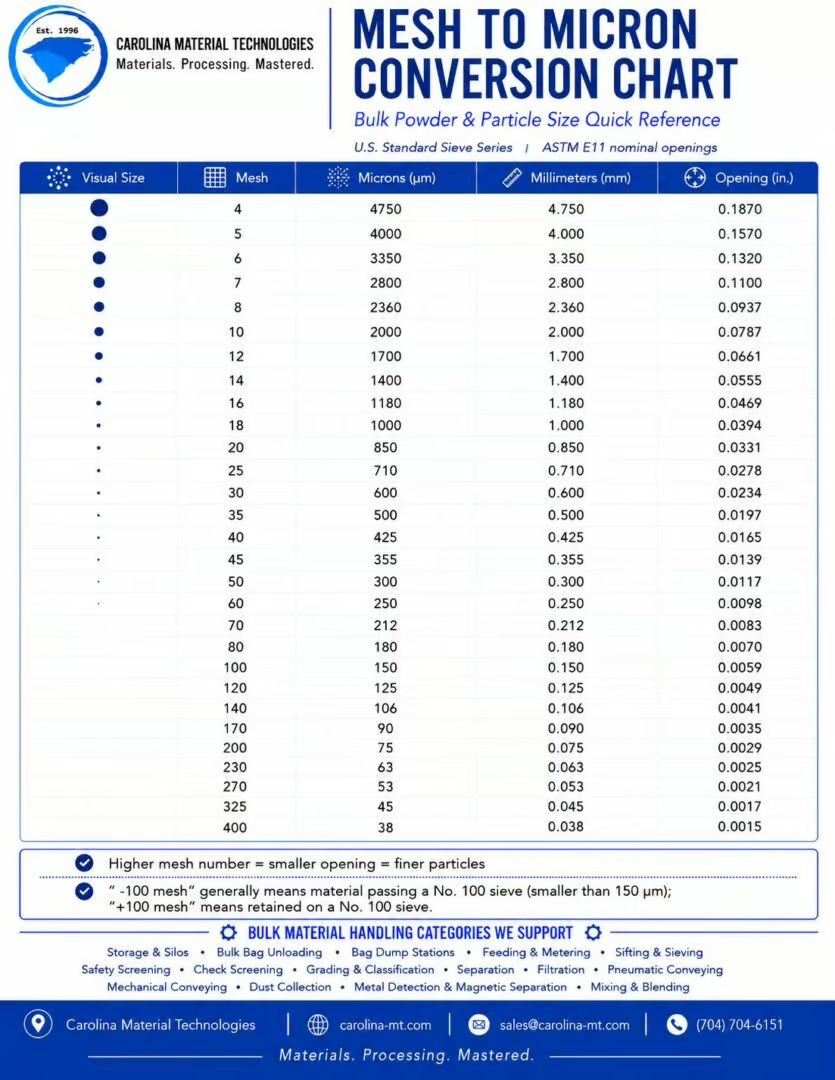
Mesh to Micron Conversion Table
Use the table below to compare mesh number with nominal opening size in microns (µm), millimeters (mm) and inches.
| U.S. Mesh | Microns (µm) | Millimeters (mm) | Opening (in.) |
|---|---|---|---|
| 4 | 4,750 | 4.750 | 0.1870 |
| 5 | 4,000 | 4.000 | 0.1570 |
| 6 | 3,350 | 3.350 | 0.1320 |
| 7 | 2,800 | 2.800 | 0.1100 |
| 8 | 2,360 | 2.360 | 0.0937 |
| 10 | 2,000 | 2.000 | 0.0787 |
| 12 | 1,700 | 1.700 | 0.0661 |
| 14 | 1,400 | 1.400 | 0.0555 |
| 16 | 1,180 | 1.180 | 0.0469 |
| 18 | 1,000 | 1.000 | 0.0394 |
| 20 | 850 | 0.850 | 0.0331 |
| 25 | 710 | 0.710 | 0.0278 |
| 30 | 600 | 0.600 | 0.0234 |
| 35 | 500 | 0.500 | 0.0197 |
| 40 | 425 | 0.425 | 0.0165 |
| 45 | 355 | 0.355 | 0.0139 |
| 50 | 300 | 0.300 | 0.0117 |
| 60 | 250 | 0.250 | 0.0098 |
| 70 | 212 | 0.212 | 0.0083 |
| 80 | 180 | 0.180 | 0.0070 |
| 100 | 150 | 0.150 | 0.0059 |
| 120 | 125 | 0.125 | 0.0049 |
| 140 | 106 | 0.106 | 0.0041 |
| 170 | 90 | 0.090 | 0.0035 |
| 200 | 75 | 0.075 | 0.0029 |
| 230 | 63 | 0.063 | 0.0025 |
| 270 | 53 | 0.053 | 0.0021 |
| 325 | 45 | 0.045 | 0.0017 |
| 400 | 38 | 0.038 | 0.0015 |
Important: Mesh number and particle size are related through the sieve opening, but mesh is not itself a particle-size measurement. Actual particle-size distributions should be established through appropriate testing. For specifications requiring precise sieve tolerances, confirm the applicable test method and current standard requirements.
What Do Mesh and Micron Mean?
Mesh and micron are two common ways of describing the size of particles and sieve openings. Understanding the difference is important when specifying screening, conveying, feeding, dust collection and other powder processing equipment.
What Is Mesh Size?
Mesh number is commonly used to identify a sieve or screen opening. As the mesh number increases, the nominal opening becomes smaller. For example, a 20-mesh sieve has a much larger opening than a 200-mesh sieve.
What Is a Micron?
A micron, also called a micrometer and written as µm, is one-millionth of a meter. Microns provide a direct dimensional measurement and are frequently used for fine powders, filtration and particle-size analysis.
Does Higher Mesh Mean Finer Material?
Yes. A higher mesh number generally represents a smaller sieve opening. Material capable of passing a 200-mesh sieve is therefore substantially finer than material that only passes a 20-mesh sieve.
Is Mesh the Same as Particle Size?
Not exactly. Mesh identifies the sieve opening used to classify material. A real powder normally contains a distribution of particle sizes rather than particles of one exact dimension.
What Do “−100 Mesh” and “+100 Mesh” Mean?
−100 Mesh
“Minus 100 mesh” generally describes material that passes through a No. 100 sieve. Using the reference above, that corresponds to material smaller than the nominal 150 µm sieve opening.
+100 Mesh
“Plus 100 mesh” generally describes material that is retained on a No. 100 sieve rather than passing through the 150 µm nominal opening.
Why Particle Size Matters in Bulk Material Handling
Particle size and particle-size distribution can influence screening performance, material flow, feeder selection, pneumatic conveying behavior, filtration requirements and equipment wear. CMT helps processors evaluate the complete material and application rather than selecting equipment from particle size alone.
Screening & Sifting
Separate by particle size, remove oversize material, perform safety screening or classify dry powders and bulk solids.
Explore Screeners & Sifters →Pneumatic Conveying
Particle size, bulk density and material behavior all affect conveying velocity, pressure requirements and system design.
Explore Pneumatic Conveying →Feeding & Metering
Particle characteristics can influence flowability, refill behavior, feed consistency and the best method for accurate dosing.
Explore Vibratory Feeders →Dust Collection
Fine airborne particles affect filter-media selection, air-to-cloth ratio, collection efficiency and dust handling requirements.
Explore Dust Collection →Particle Size Is Only Part of the Application
Two powders with the same mesh specification can behave very differently in a processing system.
When CMT evaluates a bulk material handling application, particle size is considered alongside the other physical properties that determine how the material will actually flow, convey, feed, separate and collect.
Common Mesh to Micron Questions
Quick answers to common particle-size and sieve conversion questions.
How many microns is 100 mesh?
A No. 100 sieve has a nominal opening of approximately 150 microns (µm), or 0.150 mm.
How many microns is 200 mesh?
A No. 200 sieve has a nominal opening of approximately 75 microns (µm), or 0.075 mm.
What mesh size is approximately 250 microns?
An opening of approximately 250 microns corresponds to a No. 60 sieve in the conversion table above.
What mesh size is approximately 500 microns?
An opening of approximately 500 microns corresponds to a No. 35 sieve in this reference chart.
Is a higher mesh number finer or coarser?
A higher mesh number indicates a smaller sieve opening and is therefore associated with finer material. For example, 200 mesh is substantially finer than 20 mesh.
Can I directly convert every micron value to a mesh number?
Not every micron value has an exact corresponding standard mesh designation. The reverse calculator above identifies the nearest sieve opening included in this reference table.
What does 80% passing 100 mesh mean?
It generally means that 80% of the tested material, by the applicable measurement basis, passed through the No. 100 sieve opening while the remaining portion was retained. The statement describes a particle-size distribution rather than one uniform particle size.
Why does particle size matter when selecting process equipment?
Particle size can influence screening efficiency, material flow, feeder performance, conveying behavior, dust generation, filtration and wear. It should be considered together with bulk density, moisture, particle shape, cohesiveness and other material properties. For help reviewing an application, contact Carolina Material Technologies .
What equipment is used to separate powders by particle size?
Industrial screeners and sifters can be used for safety screening, scalping, check screening, classification and removal of oversized material. Visit our industrial screeners and sifters page to explore equipment options.
Have a Powder or Bulk Material Application?
Send us your material, particle-size information, bulk density, required capacity and process goals. Carolina Material Technologies can help evaluate equipment and system options for screening, feeding, conveying, dust collection, separation and complete bulk material handling systems.