
Welded & Bolted Silos Engineered as a Complete Material Handling System
A silo is only as reliable as the equipment around it. Carolina Material Technologies helps specify welded and bolted dry bulk silos together with the right filling, venting, level control, flow aids, discharge equipment, feeding and conveying system for your material and process.
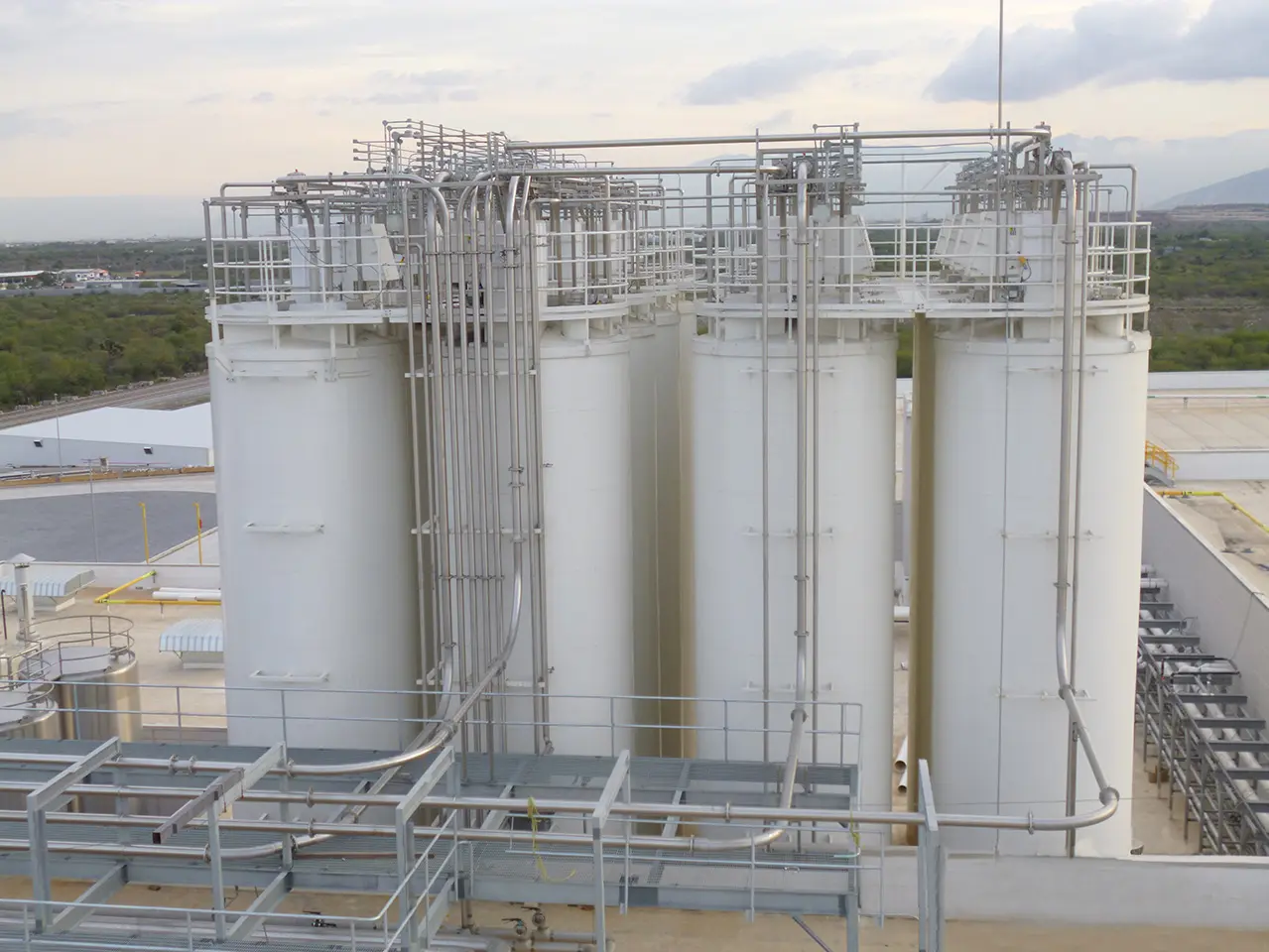
A Great Silo System Is More Than the Silo
Many storage problems start at the interfaces: the truck fill line, the bin vent, the cone, the feeder, or the conveying line leaving the silo. We look at the entire material path so each component performs as part of one coordinated system.
The goal is not simply to store material. It is to receive it cleanly, protect the vessel during filling, know how much inventory is available, promote dependable discharge, meter or isolate the solids correctly, and move them to the next process without creating a new bottleneck.

Venting & Dust Collection
Bin vents or dust collectors sized around displaced air and the actual pneumatic filling rate help control dust and protect the silo.
Explore dust collection →Level & Overfill Controls
Point-level switches, continuous inventory measurement, alarms and PLC/HMI integration provide visibility and safer filling.
Explore level controls →Aeration & Flow Aids
Air pads, pulsed aeration and other flow-aid strategies can help address compaction, bridging, rat-holing and inconsistent flow.
Explore bin aeration →Bin Activators & Dischargers
For cohesive or difficult materials, a properly selected discharger can improve live storage and promote dependable outlet flow.
Explore bin activators →Isolation Gates & Valves
Slide gates, knife gates and diverters provide isolation, maintenance access and routing where the process requires it.
Explore gates & valves →Rotary Airlocks
Rotary valves can meter or isolate material while maintaining the pressure differential required for pneumatic conveying systems.
Explore rotary valves →Feeding & Metering
Screw, vibratory and gravimetric feeding options are selected around the material, required rate, accuracy and process duty.
Explore screw feeders →Conveying to the Process
Pneumatic or mechanical conveying is designed around distance, elevation, material behavior, required rate and product integrity.
Explore pneumatic conveying →Truck Fill & Blower Systems
Blower packages, line sizing and airflow selection matter when the silo is filled pneumatically or integrated into a conveying system.
Explore blower packages →Weighing, Controls & Interlocks
Load cells, scales, PLC logic, permissives, alarms and sequencing can tie storage, feeding and conveying into one operating strategy.
Ask CMT about controls →Welded vs. Bolted Dry Bulk Silos
Neither construction style is automatically “better.” The right choice depends on storage capacity, site logistics, transportation limits, erection requirements, material characteristics and how the silo must integrate with the rest of the plant.

Fast installation when one-piece delivery works
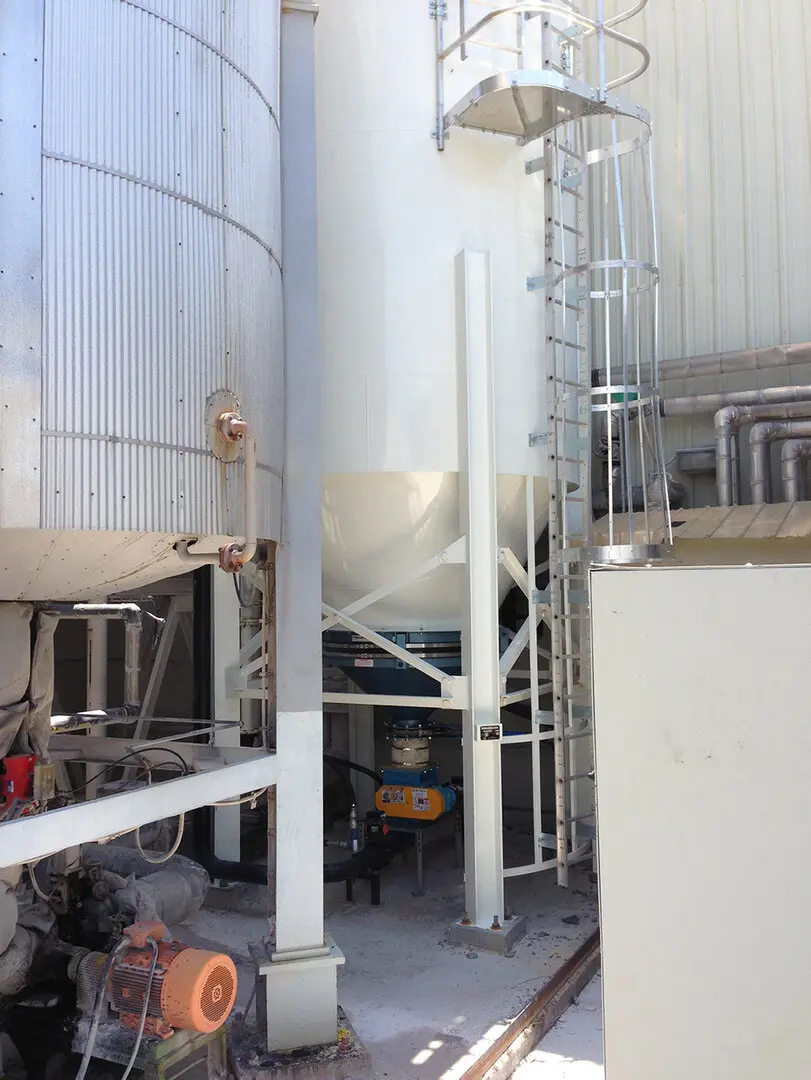
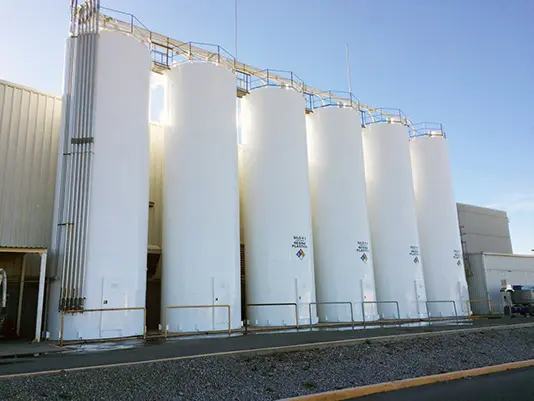
Shop-welded silos arrive substantially complete, minimizing field assembly. They are often a strong choice when site access and transportation allow the vessel to be delivered and crane-set as a large finished assembly.
- Minimal field assembly and welding
- Controlled shop fabrication and finishing
- Carbon steel, stainless steel and aluminum options
- Skirt, leg and elevated support arrangements
- Strong fit for many powder, pellet, mineral and food applications

Field-erected flexibility for larger or constrained projects
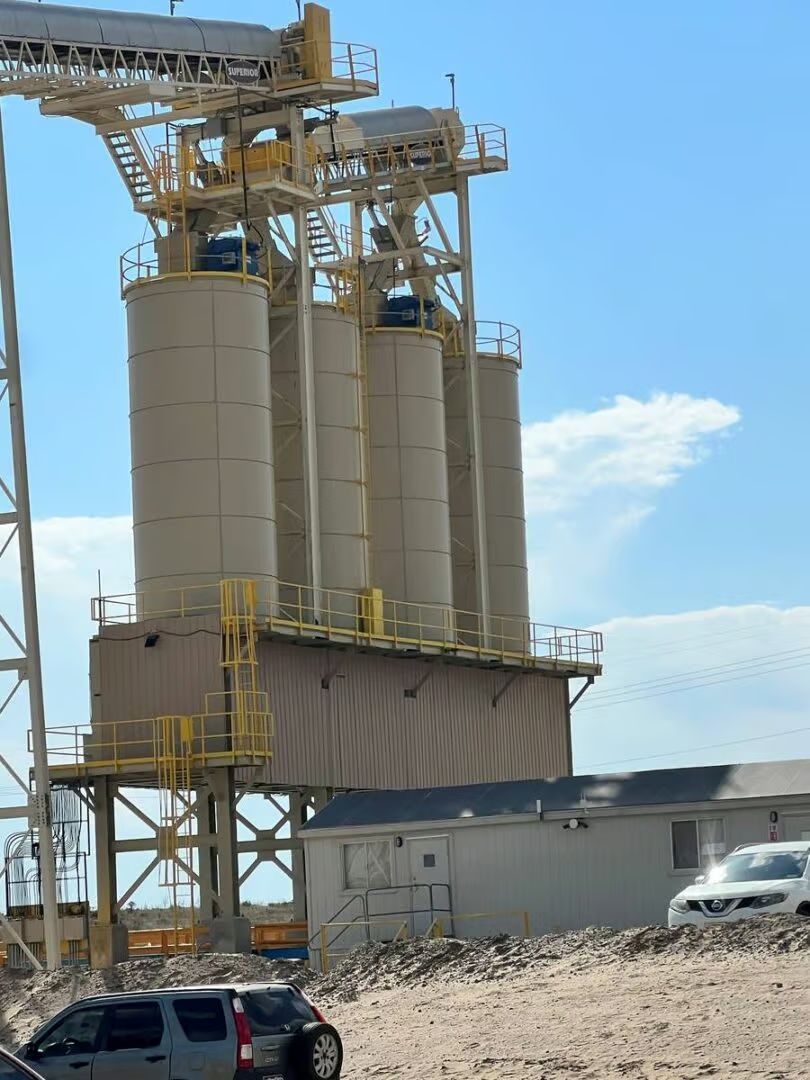
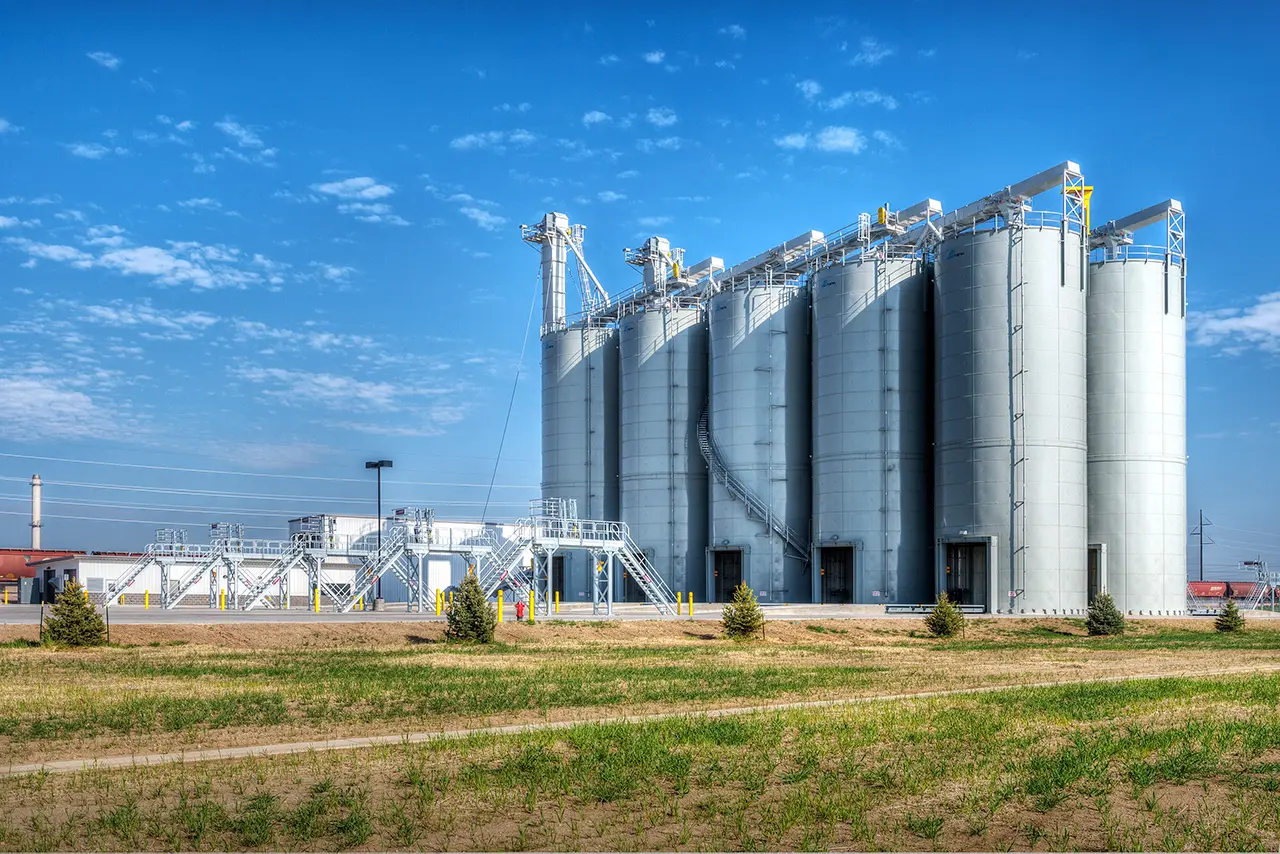
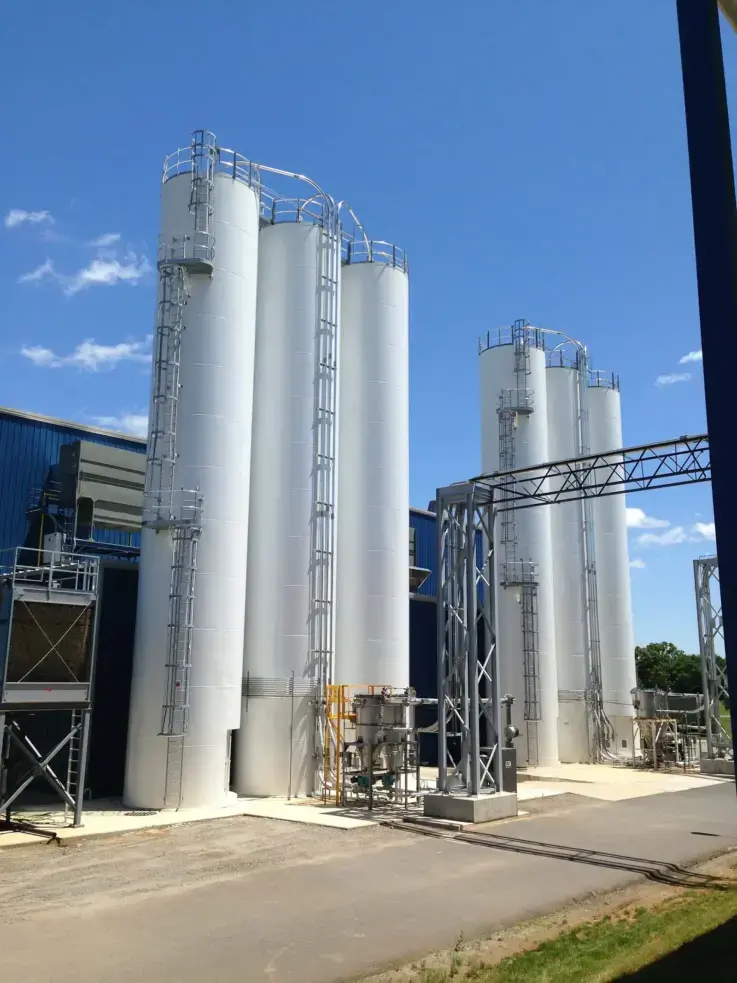
Bolted silos ship as engineered panels for on-site erection, reducing the transportation constraints that limit one-piece vessels. CMT represents AST Storage for bolted dry bulk silo applications.
- Panelized construction for field erection
- Well suited to larger storage volumes and constrained delivery access
- Factory powder-coated epoxy steel construction from AST Storage
- Multiple hopper, skirt, structure and loadout arrangements
- Designed to integrate with filling, venting, discharge and conveying equipment
AST Storage Bolted Dry Bulk Silos
Carolina Material Technologies represents AST Storage for engineered bolted dry bulk silo applications. AST manufactures bolted powder-coated epoxy storage systems for dry bulk and other industrial storage markets.
For dry bulk service, AST lists applications including sand, cement, fly ash, grain, resin and other industrial materials, with hopper slopes available from 45° to 70° depending on the storage and flow requirement.
CMT adds the application engineering around the vessel: truck fill connections, dust collection, pressure protection, level monitoring, aeration or flow aids, outlet valves, feeders, loadout equipment and conveying to the downstream process. For deeper specifications, applications and AST-specific engineering details, visit our AST bolted dry bulk silos page.




Shop-Fabricated Welded Silos
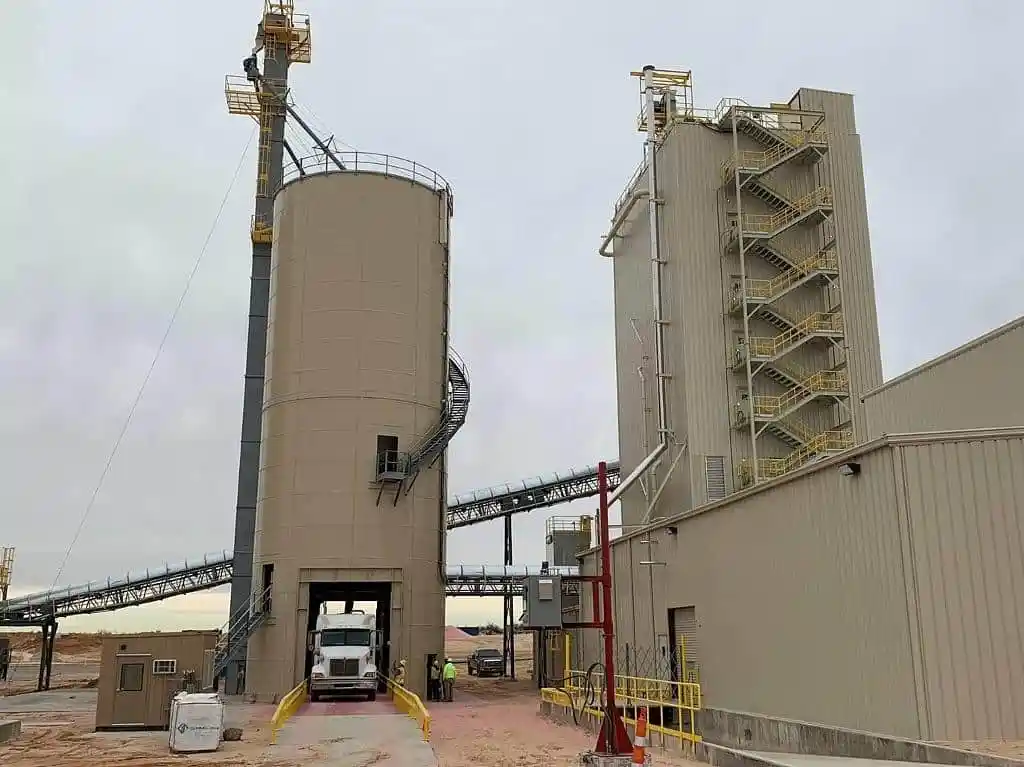
Welded silos are an efficient option when a substantially complete vessel can be fabricated in the shop, transported to the site and crane-set onto the prepared foundation or support structure.
Available fabrication and finishing options depend on the application, but commonly include carbon steel, stainless steel and aluminum construction, custom hopper geometries, industrial coatings, skirt or leg supports, platforms, ladders and process connections. Transportation dimensions and site access are important early design inputs. For deeper information on shop fabrication, construction materials, coatings, support arrangements and pre-installed equipment, visit our welded dry bulk silos page.


How CMT Approaches Silo System Design
The best equipment selection starts with the material and the operating sequence—not with a catalog model number.
Define the bulk solid
Material name, bulk density, particle size, moisture, temperature, abrasiveness, cohesiveness and flow behavior establish the design basis.
Establish required capacity
Working inventory, delivery quantity, reserve capacity, usable volume and site footprint help determine silo size and geometry.
Design the filling method
Truck, rail, pneumatic transfer or mechanical filling determines line routing, airflow, receiving rate, filtration and fill controls.
Engineer dependable discharge
Hopper slope, outlet size, mass-flow or funnel-flow requirements and flow aids are evaluated around the actual bulk-solid behavior.
Select the feeder or valve
Isolation, metering, batching and airlock requirements determine whether the outlet needs a gate, rotary valve, screw feeder or other device.
Connect it to the plant
Conveying, controls, instrumentation, weighing, alarms and interlocks are coordinated so the storage system operates as one process.
See the Design Process Applied to Real Bulk Material Challenges
These projects show why silo design cannot stop at vessel capacity. Material behavior, receiving method, dust control, inventory measurement, discharge, feeding accuracy and the downstream process all influence what belongs around the silo.
Each example highlights a different reason the equipment around the silo matters.
 Hydrated Lime • Emissions Control
01
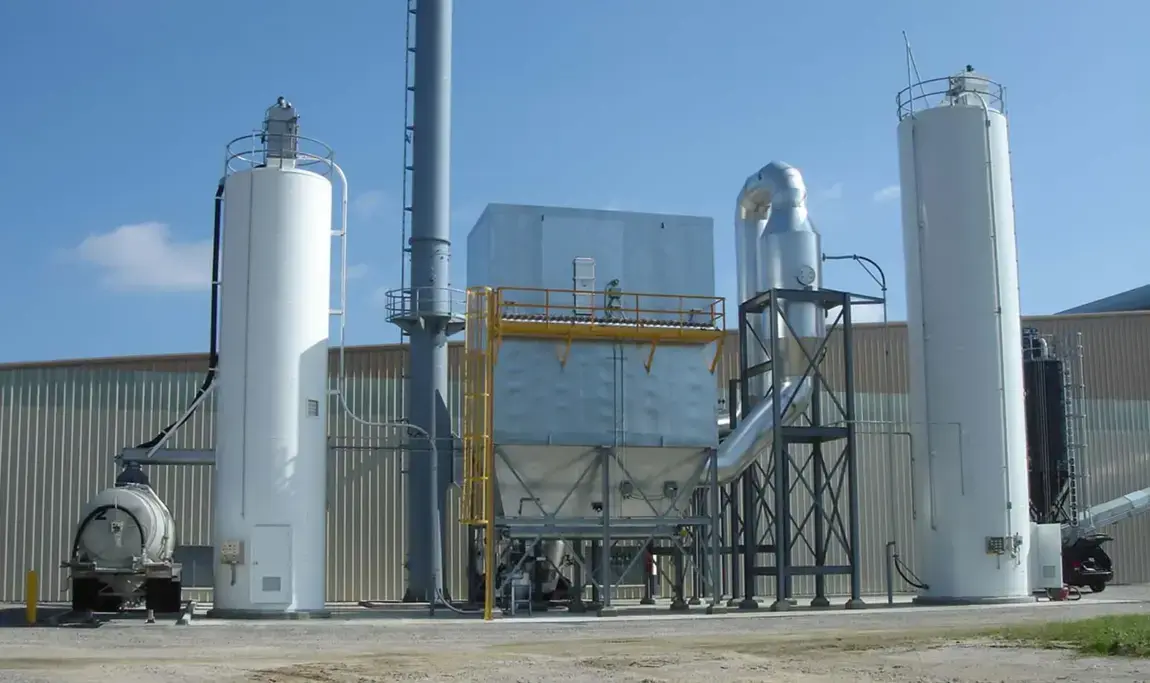
Hydrated Lime Flue Gas Mitigation System
A brick manufacturer required a turnkey hydrated-lime handling system to support emissions compliance while managing an extremely dusty material that can become difficult to discharge when stagnant.
- 12-ft. diameter welded silo with bin activator, bin vent, level controls and fill piping.
- Loss-in-weight feeder weighed and recorded hydrated lime delivered to the flue-gas stream.
- Rotary airlock and pressure conveying transferred lime to the insulated ductwork.
- Dust collection and dense-phase transfer handled reacted material.
- A second silo provided spent-lime storage and controlled truck loadout.
Polyethylene • Railcar Unloading
02
Railcar Unloading & Multi-Silo Storage
A plastics producer needed to receive and route polyethylene pellets and powder from railcars into three storage silos while protecting product quality and maintaining reliable inventory visibility.
- Rail-spur unloading with blower, air cooler, filter receivers, piping and diverter valves.
- Three 1,000-cubic-foot storage silos with vacuum boxes at the outlets.
- Air cooling reduced conveying temperature and helped minimize streamer formation.
- SiloPatrol continuous level measurement with computerized trending and alarms.
- Rotary valves, point-level probes, maintenance gates and PLC-based controls.
 Composite Decking • Greenfield Plant
03
Greenfield Composite Decking System
A new composite-decking facility required bulk receiving, storage, weighing, batching, mixing and conveying to fourteen extrusion lines as one integrated material-handling process.
- Four raw-material silos received the major ingredients.
- Three mass-flow day tanks provided intermediate mixed-product storage.
- Day tanks were weighed for inventory and equipped with rotary airlocks.
- Eleven blower packages supported the plant-wide pneumatic conveying network.
- Forty-nine loss-in-weight feeders supplied extruders and co-extruders under PLC control.
Wood Chips • Difficult Flow
04
Mycelium Mixing Plant — Wood Chip Storage
Wood chips created a difficult-flow storage challenge. The vessels and discharge equipment therefore had to be engineered around the material's tendency to bird-nest and the batching system below.
- Truck unloading and pneumatic conveying transferred chips into two 18.5-ft. diameter silos.
- Each vessel stored approximately 200,000 lb of material.
- An internal rotating screw in the silo cone promoted reliable discharge.
- A horizontal screw feeder transferred material into a tubular drag chain conveyor.
- The conveyor delivered wood chips to the majors weigh hopper for controlled batching and mixing.
Venting and pressure protection must match how the silo is filled
Pneumatic filling displaces air from the vessel. The filter, vent area, pressure/vacuum relief, fill line and controls should be selected as a coordinated system rather than as isolated components.

The outlet must feed the next process—not simply empty the silo
A system may need free discharge, controlled metering, pressure isolation, weighing, batching, or transfer into a pneumatic or mechanical conveyor. The discharge equipment should be selected accordingly.
Industrial Silo Systems for Powders, Pellets, Granules & Bulk Solids
Silo geometry, material of construction, coatings, flow aids and discharge equipment should be selected around the stored product and its operating environment.
Dry Bulk Silo System FAQs
Should I choose a welded or bolted silo?
Welded silos can offer very fast field installation because much of the fabrication is completed in the shop, but transportation and site access limit the practical one-piece size. Bolted silos are panelized for field erection, which can make them a better fit for larger capacities, constrained access or projects where shipping a complete vessel is impractical. CMT can compare both options around your project.
What information is needed to size a dry bulk silo?
Start with material name, loose and/or settled bulk density, desired working capacity, delivery quantity, filling method, receiving rate, particle size, moisture, temperature and any known flow problems. Site footprint, elevation constraints and the required discharge rate are also important.
Why does silo venting matter during pneumatic filling?
Pneumatic filling moves conveying air into the silo along with the product. That displaced air must leave through a properly selected filter or vent system while the vessel remains within its allowable pressure and vacuum limits. Venting, pressure relief, overfill protection and fill-line controls should therefore be evaluated together.
How do you prevent bridging or rat-holing in a silo?
Reliable flow begins with the material properties, hopper geometry and outlet size. Depending on the product, the solution may also include air pads, pulsed aeration, a bin activator, vibration or another flow-aid strategy. The correct device depends on why the material is failing to flow.
What equipment can be installed below a silo?
Common equipment includes slide or knife gates, rotary airlocks, screw feeders, vibratory feeders, load cells, weigh hoppers and pneumatic or mechanical conveying equipment. The best arrangement depends on whether the process needs simple isolation, controlled feeding, weighing, batching or pressure sealing.
Can CMT provide the complete silo handling system?
Yes. CMT can help coordinate the silo with receiving, filtration, pressure protection, level measurement, flow aids, valves, feeders, weighing, conveying, blowers and controls. The project scope can range from a stand-alone silo and accessories to a more complete dry bulk handling system.
Planning a New Silo or Upgrading an Existing Storage System?
Send us the material, required storage capacity and how the product enters and leaves the silo. We can help determine the right vessel construction and the equipment needed around it.
Helpful information to send
- Material name and bulk density
- Required storage capacity
- Truck, rail or plant-transfer filling method
- Target receiving and discharge rates
- Known flow or dust problems
- Site drawings, photos or available footprint