
Mechanical Conveying Systems for Powders & Bulk Solids
Moving bulk material reliably is not simply a matter of choosing a conveyor. Product characteristics, conveying rate, elevation, routing, sanitation, dust containment, degradation and downstream equipment all influence which technology will perform best. Carolina Material Technologies helps manufacturers compare and integrate mechanical conveyor systems for powders, pellets, granules, flakes and other bulk materials.
 Engineered Mechanical Conveying
Start With the Material — Not the Conveyor
There is no single “best” mechanical conveyor. The right system is the one that matches the physical behavior of your material and the demands of the complete process. We typically evaluate these factors before recommending a conveying method.
Material Characteristics
Bulk density, particle size, flowability, moisture, abrasiveness, temperature, cohesiveness and tendency to degrade all influence conveyor selection.
Required Throughput
Continuous rate, batch size, peak demand and future capacity should be considered rather than sizing around an average rate alone.
Conveying Path
Horizontal distance, vertical lift, incline angle, bends, available floor space and overhead clearance can quickly narrow the options.
Product Integrity
Fragile products, blended ingredients and materials prone to segregation may require gentler conveying and fewer transfer points.
Containment & Sanitation
Dust control, washdown requirements, allergens, cross-contamination, cleanability and environmental exposure should be considered early.
Process Integration
The conveyor must work with the equipment before and after it: unloaders, silos, feeders, scales, mixers, screens, packaging and controls.
A Quick Starting Point
These are useful starting points—not hard rules. Final selection should be based on the actual material, required rate and complete conveying route.
Mechanical Conveying Technologies for Different Applications
CMT can compare multiple mechanical conveying technologies rather than forcing every application into one equipment style. Each technology has a distinct operating principle and application sweet spot.

TipTrak® Bucket Conveyors
TipTrak® continuous bucket conveyors move material horizontally and vertically through one conveying path using interlocking buckets and a positive-drive belt-chain. The design is especially valuable when product degradation, spillage, segregation or dust generation at transfer points needs to be minimized.
- Horizontal-to-vertical conveying can reduce intermediate transfer points.
- Interlocking buckets help contain product along the conveying path.
- Open, P.E.C., Monocoque and sanitary configurations are available.
- Useful for powders, granules, pellets and delicate products.

Aero-Mechanical Conveyors
Aero-mechanical conveyors move bulk material through enclosed tubing using evenly spaced discs attached to a continuous wire rope. The rapidly moving discs create an air stream that carries material through the conveyor, allowing high throughput and effective vertical transfer.
- Convey horizontally, vertically or at intermediate angles.
- High conveying rates through relatively compact tubing.
- Enclosed construction helps contain dust and material.
- Self-emptying characteristics can improve batch integrity and product changeovers.

Industrial Screw Conveyors
Screw conveyors use rotating helical flighting to move bulk material through a trough or tube. Their rugged operating principle makes them one of the most versatile mechanical conveying technologies for demanding industrial powder and bulk solids applications.
- Horizontal, inclined and specialized vertical designs.
- Sectional, ribbon, cut-and-folded, variable-pitch and specialized flighting.
- Carbon steel and stainless-steel construction.
- Can be engineered around abrasion, temperature, high torque and difficult materials.

Flexible Screw Conveyors
Flexible screw conveyors use a rotating flexible auger inside an enclosed tube to transport dry powders and granules. They can provide a simple, compact and economical solution when the material characteristics and conveying route are well suited to the technology.
- Simple design with one primary moving component.
- Enclosed tubing helps contain product and nuisance dust.
- Integrates with bag dumps, bulk bag unloaders, mixers and packaging equipment.
- Application review is important for highly abrasive, aeratable, cohesive or fragile products.
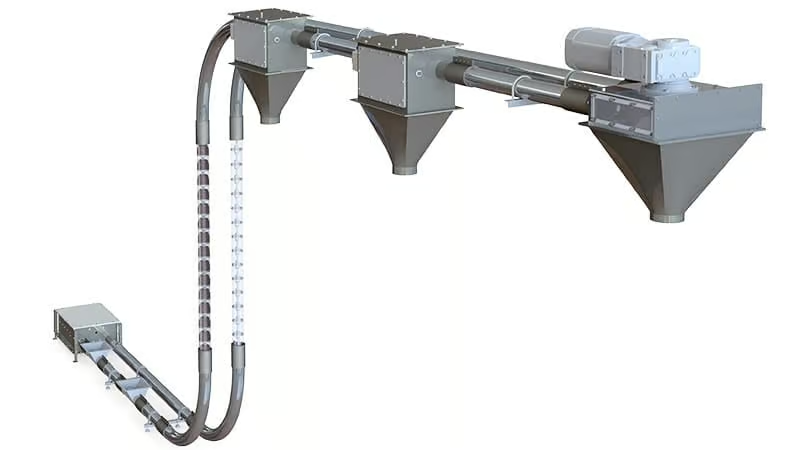
Chain-Vey® Tubular Drag Chain Conveyors
Tubular drag chain conveyors use polymer discs attached to a chain to pull bulk material gently through sealed tubing. They are particularly useful when a process requires product protection, dust containment, multiple direction changes or sanitary cleaning options.
- Combine horizontal and vertical conveying in one system.
- Gentle transport helps minimize breakage and blend declassification.
- Multiple inlets and discharge points can be incorporated.
- Cleaning configurations range from dry clean-out through full wet CIP systems.
KleanTrak® Sanitary Belt Conveyors
When washdown, allergen control and hygienic access are more important than completely enclosed conveying, KleanTrak provides a purpose-built sanitary belt conveyor for food, pharmaceutical, nutraceutical and other high-care manufacturing environments.

Built Around Cleanability
KleanTrak is a cleated sanitary belt conveyor engineered around fast cleaning, inspection and hygienic operation. Instead of surrounding the belt with difficult-to-access structure, the conveyor uses an open stainless-steel frame with minimal horizontal surfaces and direct access to the product zone.
- Open 304 stainless-steel frame designed for cleaning and inspection access.
- Sanitary polyurethane belt available with cleats, scoops and corrugated sidewalls.
- Tool-free access helps simplify cleaning and product changeovers.
- Washdown-duty drive components and corrosion-resistant bearings.
- Belt can be accessed for more thorough cleaning, sanitation and inspection.
- Available options include mobile bases, drain pans, CIP systems, guarding, chutes and tilting mechanisms.
Consider KleanTrak when the primary challenge is not simply moving product vertically, but making the conveyor straightforward to inspect, wash and sanitize between production runs.


LinkTrak® Modular Belt Conveyors
LinkTrak is a specialized UniTrak belt conveyor concept for applications that benefit from gentle mechanical transport but are better suited to a continuous belt than individual buckets. It can also be engineered for multiple controlled discharge locations along a conveying line.
Gentle Belt Handling with Flexible Discharge Options
LinkTrak uses a continuous belt conveying surface rather than the individual buckets used by a TipTrak. This creates an alternative for products that benefit from gentle mechanical transport but do not require bucket containment.
Because the conveyor can be engineered as a modular system, LinkTrak is particularly interesting for processes that need to distribute product to several downstream destinations from a common conveying line.
- Continuous belt transport rather than individual buckets.
- Suitable for gentle transfer of powders, granules, pellets and other appropriate bulk products.
- Can be engineered with multiple selectable discharge locations.
- Pneumatically operated plow-style discharge assemblies can divert material at designated stations.
- Modular conveyor construction can be tailored around process layout and required discharge spacing.
A conventional belt conveyor is excellent for simple point-to-point transfer. LinkTrak becomes more compelling when the application needs a more engineered belt system, gentle material handling or several controlled discharge destinations along the same conveyor.
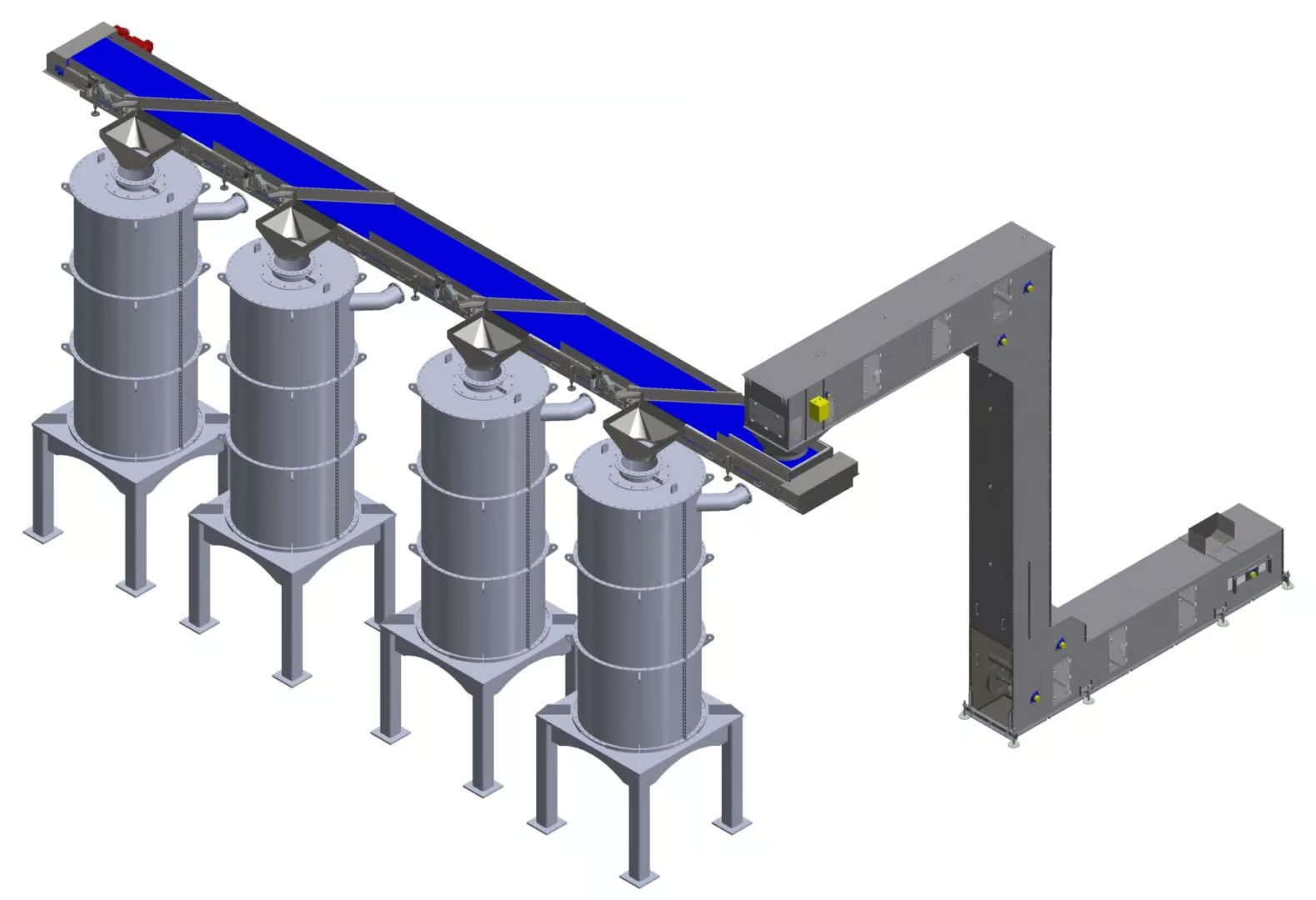


LinkTrak Conveyor Demonstration
Which Mechanical Conveyor Is Right for Your Application?
Use this chart as an initial screening tool. Actual suitability, capacity and configuration depend on the material properties, conveyor geometry and operating conditions.
| Technology | Typical Sweet Spot | Routing | Product Protection | Sanitation / Containment | Key Consideration |
|---|---|---|---|---|---|
| TipTrak® Bucket | Fragile materials, vertical elevation and processes where reducing transfer points is important. | Horizontal + vertical in one continuous path. | Open through dust-tight and sanitary designs. | Strong option where breakage, segregation or spillage carries a high cost. | |
| KleanTrak® Belt | Food, pharmaceutical and high-care applications where frequent washdown and sanitation are major priorities. | Horizontal, incline and engineered elevation configurations. | Exceptional cleaning access with open sanitary design. | Best evaluated when hygienic design and fast cleanability are more important than fully enclosed conveying. | |
| LinkTrak® Belt | Gentle continuous belt transfer and specialized multi-discharge applications. | Engineered point-to-point or distribution layouts. | Application specific. | Particularly interesting when several controlled discharge points are required from a common conveyor. | |
| Aero-Mechanical | High-throughput powder and granular transfer, especially with significant elevation. | Horizontal, vertical or inclined. | Fully enclosed conveying tube. | Material characteristics should be reviewed for sticky materials, large lumps and severe abrasion. | |
| Industrial Screw | Heavy-duty industrial service, controlled transfer and short-to-moderate conveying distances. | Horizontal, inclined and specialized vertical designs. | Enclosed trough or tube designs. | Flight design, loading and speed must match the actual bulk material. | |
| Flexible Screw | Compact, economical transport of suitable powders, granules and small pellets. | Horizontal, inclined and gently curved routes. | Enclosed tube with sanitary/easy-clean options. | Abrasiveness, aeration, compaction and degradation should be evaluated. | |
| Chain-Vey® Tubular Drag | Gentle enclosed transfer over long or complex paths with multiple inlets or discharges. | Horizontal + vertical + multiple direction changes. | Sealed tubing with dry-clean through full CIP options. | Valuable where product quality, containment or sanitation justifies a more engineered conveyor system. |
Mechanical Conveying vs. Pneumatic Conveying
Many projects are not simply a choice between different mechanical conveyors. The bigger question is whether the material should be moved mechanically or through a pneumatic conveying line. CMT works with both technologies, allowing the decision to be based on the process rather than a single equipment line.
Mechanical Conveying
Often a strong choice when direct physical movement of the product provides advantages in product integrity, energy use or process control.
- Gentle handling options for fragile products
- Reduced dependence on conveying air
- No pneumatic conveying air to separate at the receiver
- Effective horizontal and vertical point-to-point transfer
- Sanitary, dust-tight and heavy-duty technologies available
Pneumatic Conveying
Often advantageous when piping flexibility, long conveying routes or moving material between distant pieces of equipment are major design priorities.
- Piping can route around existing plant obstacles
- Useful for longer or highly distributed conveying paths
- Pressure and vacuum configurations available
- Enclosed transfer from source to destination
- Can integrate multiple pickup or receiving points
The Conveyor Is Only One Part of the Material Path
A well-selected conveyor can still perform poorly if the equipment feeding or receiving it is not designed correctly. CMT can review the complete material path—from storage and unloading through feeding, conveying, processing and final discharge.
Unload & Introduce
Get material into the conveying system cleanly and consistently from bags, bulk bags or upstream storage.
Store & Discharge
Reliable conveying starts with consistent material flow from silos, bins, hoppers and day bins.
Feed & Meter
Feeders can isolate the conveyor from uncontrolled surge flow while providing the rate required by downstream equipment.
Mix & Process
Mechanical conveyors can charge mixers, blenders, reactors and other process equipment as part of complete ingredient systems.
Contain Dust
Enclosed conveyors can reduce dust generation while properly designed collection addresses displaced air and dusty transfer points.
Integrate the Process
Conveyors can be integrated into larger unloading, storage, batching, weighing, mixing and automated bulk material handling systems.
Mechanical Conveying for a Wide Range of Bulk Materials
Conveyor design should be based on the actual material rather than the industry name alone. CMT works with powders, pellets, granules, flakes, grains and other bulk solids across a wide range of manufacturing processes.
Food & Ingredients
Flour, sugar, grains, coffee, snacks, cereal, powders, spices, bakery ingredients and other food products.
Plastics & Resins
Pellets, regrind, flakes, powdered resins, compounds, fillers and additives.
Chemicals
Specialty powders, granules, additives, pigments and formulated chemical ingredients.
Minerals & Building Products
Lime, calcium carbonate, cementitious powders, sand, minerals and dense or abrasive bulk solids.
Agriculture & Feed
Grain, seed, feed ingredients, supplements and other agricultural bulk materials.
Pharmaceutical & High Care
Products requiring controlled handling, frequent cleaning, sanitary construction or reduced contamination risk.
How We Approach a Conveyor Application
The objective is not to sell the most complicated conveyor. It is to identify the simplest reliable solution that satisfies the material, process and operating requirements.
Define the Material
Review bulk density, particle characteristics, flow behavior, temperature, moisture and special handling concerns.
Define the Duty
Establish rate, operating hours, batch requirements, elevation, horizontal distance and system availability.
Compare Technologies
Evaluate mechanical conveyor options—and pneumatic conveying when appropriate—against the process requirements.
Integrate the System
Coordinate infeed equipment, transitions, feeders, controls, dust collection and downstream equipment.
Frequently Asked Questions
What information is needed to size a mechanical conveyor?
Important information includes the material name, loose bulk density, particle size, required conveying rate, horizontal distance, vertical lift, number of bends or direction changes, temperature, moisture, abrasiveness, sanitation requirements and upstream/downstream equipment.
What is the difference between mechanical and pneumatic conveying?
Mechanical conveyors physically move material using buckets, screws, belts, discs or other conveying elements. Pneumatic systems transport material through piping using a moving air stream. Neither method is universally better; the correct choice depends on material behavior, distance, route, rate and product integrity.
Which conveyor is best for fragile materials?
TipTrak bucket conveyors and Chain-Vey tubular drag conveyors are frequently evaluated where very gentle product handling is important. LinkTrak and other belt conveying methods may also be suitable depending on the product and conveying path.
What type of conveyor is best for sanitary washdown applications?
KleanTrak is specifically designed around hygienic belt conveying and washdown access. TipTrak and Chain-Vey systems can also be configured with sanitary or clean-in-place options when enclosed conveying is preferred.
What is a multi-discharge conveyor?
A multi-discharge conveyor allows material to leave the same conveying line at several selectable locations. Specialized designs such as LinkTrak can use controlled plow-style discharges to route material to different downstream process points.
Can one conveyor move material horizontally and vertically?
Yes. TipTrak bucket conveyors, Chain-Vey tubular drag conveyors and aero-mechanical conveyors are examples of technologies that can combine horizontal and vertical conveying within a single system.
Can mechanical conveying systems be dust-tight?
Yes. Several mechanical conveying technologies can be supplied in enclosed or sealed configurations. Tubular drag conveyors, aero-mechanical conveyors, enclosed screw conveyors and enclosed bucket conveyor designs can all help contain material and dust when correctly engineered.
Can CMT provide more than the conveyor itself?
Yes. Mechanical conveyors can be integrated with bulk bag unloaders, bag dump stations, silos, bins, feeders, weighing systems, mixers, dust collection, screening equipment, valves and controls as part of a complete bulk material handling system.
Let’s Find the Right Way to Move Your Material
Send us your material, bulk density, required rate, horizontal distance, vertical lift and a basic layout. We can compare the appropriate mechanical conveying technologies—and pneumatic conveying where it makes sense—to identify the best fit for your process.