
Powderflight™ aero-mechanical conveyors for high-capacity powder and granule conveying
Move powders and granules at virtually any angle with gentle handling, low attrition, dust-tight containment, and no filtration typically required at the discharge. Powderflight™ aero-mechanical conveyors are ideal for high-output conveying of food, chemicals, minerals, and other bulk solids.

Ideal when you need high conveying rates, gentle handling, and dust-tight movement of powders or granules in a compact layout.
Why choose an aero-mechanical conveyor?
Aero-mechanical conveyors use polymer discs mounted on a continuous wire rope to create moving air pockets that carry product through the conveying tubes. The result is a fast, dust-tight conveying method that handles powders and granules gently while maintaining strong throughput.
- High output relative to cost and power for many powder and granule applications.
- Minimal blend separation helps preserve formulation consistency.
- Dust-tight conveying path supports cleaner plant operation and less mess.
- Portable, fixed, sanitary, and custom layouts can be matched to the process.

How Powderflight™ aero-mechanical conveyors work
The conveying principle is simple but highly effective: rotating discs pull both air and product through the tubes, creating a gentle, efficient conveying action that works across a wide range of bulk solids.
Product enters the inlet
Material feeds into the conveyor where it is picked up by moving air pockets created by discs on a continuous rope.
Discs move product through the tubes
The rope and disc assembly carries product smoothly through vertical, inclined, or multi-path conveyor layouts.
System self-empties at shutdown
That helps reduce leftover product in the conveyor and typically eliminates the need for filtration at the receiving vessel.
Configurations and options
Powderflight™ aero-mechanical conveyors can be configured for fixed plant installations, portable conveying, vertical-to-incline transfer, mobile bag dump stations, and horizontal/vertical multi-path systems.

 Portable base configuration
 Vertical-to-incline conveying
 Portable production base
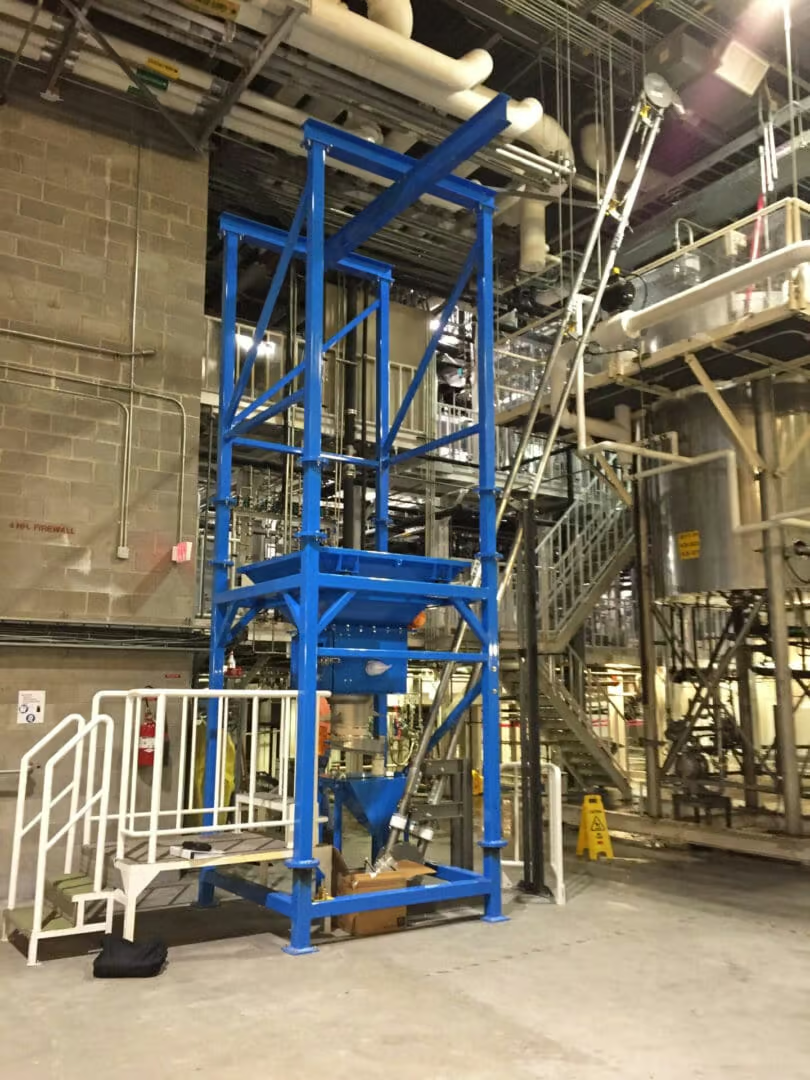
 Mobile bag dump station
 Horizontal / vertical multi-path
Vertical, inclined, or right-angle layouts
Supports at inlet with top or bottom-mounted drive, bolted tubes with seals for dust containment, and custom infeed hoppers or discharge connections.
Mobile base and integrated controls
Roll-up, plug-in conveying with optional bag dump hood and dust collection for flexible use across different lines, products, or campaigns.
Manual bag dumping into the conveyor
Mobile or fixed bag dump stations can feed the conveyor while dust collection helps protect operators and keep the work area cleaner.
Horizontal and vertical conveying paths
Powderflight™ systems can be routed in horizontal/vertical paths to move material around plant constraints while keeping transfer enclosed.
Applications and materials handled
Aero-mechanical conveyors are a strong fit when you need gentle, enclosed movement of free-flowing powders or granules without sacrificing throughput. The Powderflight™ brochure lists a wide range of materials handled, including food ingredients, chemicals, minerals, pigments, resins, and plastic granules.
Food ingredients
Sugar, flour, milk powder, coffee, starch, spices, dehydrated foods, and other materials that benefit from gentle handling and clean conveying.
Chemicals and pigments
TiO₂, pigments, detergents, resins, urea prills, iron oxide, zinc oxide, and powders where dust control and consistent movement are important.
Minerals and bulk solids
Talc, calcium carbonate, cement, sand, silica, perlite, gypsum, limestone powder, and other dry bulk materials.
Capacities and sizes
Actual output depends on the product, rope speed, layout, and material characteristics. Testing is recommended to validate performance and optimize rope selection.
| Model | Capacity @ 200 RPM* | Typical Tube OD | Notes |
|---|---|---|---|
| M75 | ~6 ft³/min | ~3–4 in | Compact layout; blends stay homogeneous |
| M100 | ~13 ft³/min | ~4–5 in | Popular all-around size for powders and granules |
| M125 | ~24 ft³/min | ~5–6 in | Higher throughput with minimal attrition |
Photos and layouts


Frequently asked questions
Do aero-mechanical conveyors require a filter or dust collector on the receiving vessel?
Not typically. Because the system creates moving air pockets and self-empties, filtration at the discharge is generally not required.
How do you maximize rope life in an aero-mechanical conveyor?
Rope life is improved through proper speed selection, correct tensioning, soft-start controls, and designing the system to start and stop empty when possible.
Can aero-mechanical conveyors handle fragile materials and blends?
Yes. One of the main benefits of the conveying principle is minimal attrition and low blend separation, which makes it suitable for many sensitive materials.
Need help sizing the right aero-mechanical conveyor?
We help plants in North Carolina and South Carolina review the material, layout, throughput, inlet arrangement, and downstream equipment requirements before recommending the right Powderflight™ configuration.