
Russell Finex Liquid Filtration
Self-Cleaning Liquid Filters
Remove oversize contamination from liquids and pastes while reducing interruptions for filter changes.
Carolina Material Technologies helps you evaluate Russell Finex self-cleaning filters for your product, flow rate, and production requirements. Explore reusable filter elements, continuous wiping, and options for demanding liquid processes.
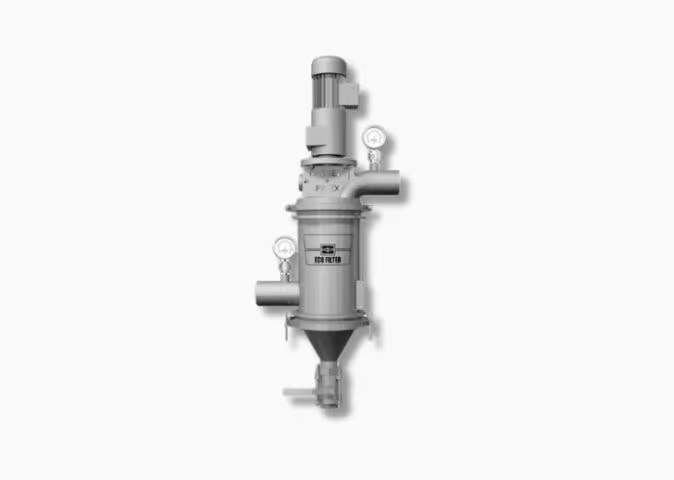
Continuous cleaning at the filter element
How a self-cleaning liquid filter works
- Separate: Liquid passes through the selected filter element, which retains particles larger than its openings.
- Wipe: The motor-driven SpiroKlene™ system continuously sweeps the element surface to help prevent buildup.
- Discharge: Retained material leaves through an oversize discharge valve, operated manually or with an appropriate automated arrangement.
The reusable element reduces reliance on disposable bags and cartridges in suitable applications. Element selection and wiper configuration are matched to the material being filtered.

Choose the configuration for your process
Russell Finex liquid filter options
Start with the filtration duty, then evaluate capacity, temperature control, cleaning requirements, and automation.

Self-Cleaning Russell Eco Filter®
Enclosed filtration for removing oversize from liquids and pastes. A reusable element and continuous wiping can reduce consumable use and interruptions associated with disposable media.

High-Temperature Filters
Configurations for hot liquids such as resins and cooking oils. Heat-resistant components and appropriate temperature control are selected for the operating conditions.

High-Flow Filtration
Evaluate larger filtration duties with a self-cleaning strainer configuration. Sizing considers viscosity, aperture, solids loading, and allowable pressure drop alongside the required flow.

Russell Hygiene Filter™
Evaluate this option for processes with specific hygiene requirements. Review contact materials, seals, surface finish, and cleaning access against your product and sanitation procedures.
Automation options
Russell Filter Management System™
Automated monitoring and discharge control can reduce manual attention to the filtration process. The Filter Management System can also help limit useful product lost during oversize discharge.
Review the discharge sequence, control requirements, and connection to your existing process when specifying the complete installation.

Equipment demonstration
See the filtration process
Explore the Russell Finex filter demonstration, then discuss how the operating principle fits your liquid product and production line.
Watch the filter video on YouTube →Applications to evaluate
Liquid filtration across production processes
The material to remove matters as much as the liquid carrying it. Share the contamination problem and the product quality requirement when discussing an application.
Food & Beverage
Chocolate, syrups, edible oils, and other liquid ingredients. Review temperature, ingredient retention, and sanitation needs.
Coatings & Chemicals
Paints, inks, adhesives, resins, and emulsions. Identify unwanted skins, agglomerates, or particles and confirm material compatibility.
Other Process Liquids
Ceramic slurries, process water, and recovered oils. Evaluate the solids load, particle characteristics, and intended use of the filtered stream.
Application review
Specify the filter around your operating conditions
Send CMT the following information to help narrow the equipment selection:
Your Product
- Liquid name and composition
- Viscosity at operating temperature
- Solids concentration and particle characteristics
- Required aperture or retention target
Your Process
- Normal and peak flow rates
- Operating pressure and allowable pressure drop
- Temperature range and heating needs
- Batch or continuous operation
Your Installation
- Pipe sizes and available space
- Cleaning method and product changeovers
- Contact materials and seal requirements
- Controls and oversize collection arrangements
Self-cleaning liquid filter FAQs
Can a self-cleaning filter replace bags or cartridges?
It can be an alternative for suitable oversize-removal applications. Compare retention performance and required filtrate quality, rather than assuming that matching a stated micron rating makes two filtration methods equivalent.
Does self-cleaning mean the filter never needs cleaning?
No. The wiper helps keep the element clear during operation. Routine inspection, maintenance, and any required cleaning between products or batches remain part of the operating procedure.
Can these filters handle viscous liquids and pastes?
Suitable configurations can handle viscous products. Selection depends on viscosity at the actual process temperature, flow behavior, solids content, aperture, and available pressure.
What determines the required filter size?
Flow rate alone is not enough. Viscosity, temperature, aperture, solids loading, and allowable pressure drop all affect selection. Provide both normal and maximum production conditions.
Is automatic oversize discharge included?
Discharge can be manual or automated, depending on the specified arrangement. Discuss the Russell Filter Management System when automatic monitoring and discharge control are required.
How does this differ from liquid-solid separation?
This page focuses on filtering unwanted oversize from a liquid product. Applications centered on recovering solids or dewatering a slurry should also be evaluated for liquid-solid separation equipment.
Find the right filter for your liquid process
Tell us what you are filtering, what needs to be removed, and the production rate you need. CMT can help evaluate Russell Finex equipment and the next steps for your application.