
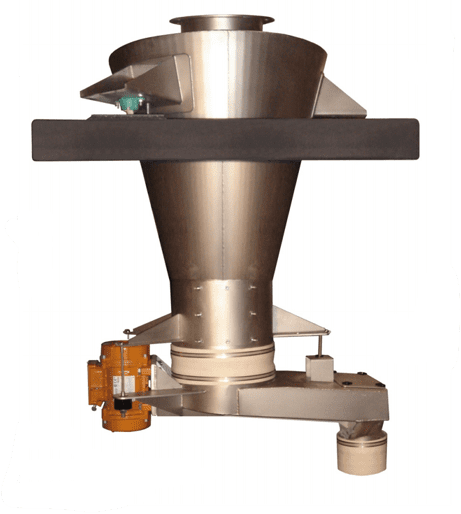
How to Fix Hopper Flow Problems (Bridging, Ratholing & Funnel Flow Explained)
Mass flow feeding is a design approach used to eliminate common bulk material flow problems like bridging, ratholing, and funnel flow.
The Problem with Traditional Flow
For decades, bulk material systems have struggled with inconsistent discharge caused by poor hopper and feeder design. These issues typically show up as:
- Bridging – material forms an arch and stops flowing
- Ratholing – material flows only through a narrow channel
- Funnel Flow – stagnant material remains along hopper walls
Historically, plants have tried to fix these issues using vibrators, air cannons, or agitation. While these methods may temporarily improve flow, they often fail to address the root cause and can create additional problems.
What is Mass Flow?
Mass flow describes a flow pattern where all material in the hopper moves uniformly at the same time, whether it is at the center or along the walls.
This results in:
- First-in, first-out (FIFO) material flow
- Elimination of stagnant zones
- More consistent and predictable discharge
Why Feeder Design Matters
Even with a properly designed hopper, flow problems can return if the feeder is not designed to maintain mass flow.
Traditional screw feeders often:
- Pull material from the front of the hopper
- Recreate funnel flow conditions
- Cause segregation, degradation, and inconsistent discharge
A proper mass flow system requires the feeder to activate the entire hopper outlet, ensuring consistent flow across the full cross-section.
Key Design Factors for Mass Flow
Achieving mass flow depends on several critical design elements:
- Hopper wall angles must exceed the material’s wall friction angle
- Outlet size must be larger than the material’s arching dimension
- Material properties such as cohesiveness and angle of repose must be considered
- Feeder geometry must promote uniform discharge across the outlet
Without proper alignment of these factors, mass flow cannot be achieved.
The Bottom Line
Mass flow feeding is not achieved through force or add-ons — it is achieved through correct engineering of both the hopper and feeder as a system.
When designed correctly, mass flow systems:
- Eliminate flow stoppages
- Improve process reliability
- Increase batching accuracy
- Reduce maintenance and downtime
If you’re experiencing flow issues, the problem is rarely the material — it’s almost always the design.