
Simple Bulk Bag Fillers
A straightforward filling station, configured around your process.
Support the bag, connect the spout, and fill from your material source. Simple FIBC filling stations provide a practical starting point for operator-managed bagging, with options for weighing, settling, and drum filling.
- Manual bag attachment and operator-coordinated removal
- Adjustable support arrangement and inflatable spout seal
- Standalone stations or integration into a larger process
Local application support for North & South Carolina.
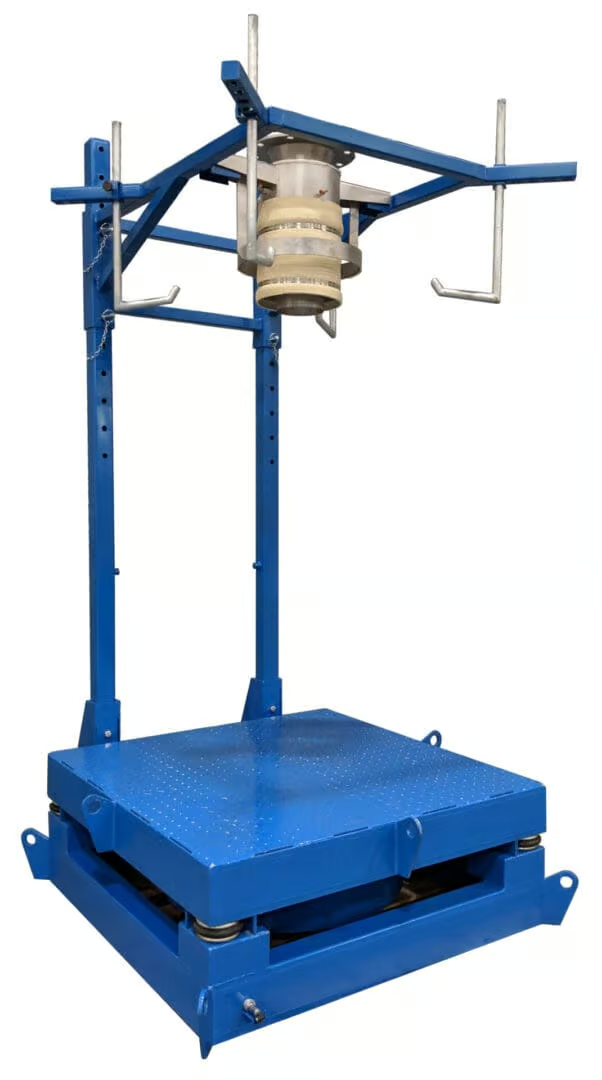
When a simple filler makes sense.
Choose a simple filling station when an operator-managed cycle fits your schedule and you want to focus investment on the functions your process needs.
Dedicated bagging point
Fill from an existing hopper, feeder, or process outlet with a defined place to support and connect the bag.
Flexible production
Accommodate planned changes in bags or products with an arrangement selected for access, adjustment, and cleaning.
A larger process line
Use the station as the filling point beneath a receiving hopper or mixer, with upstream equipment supplying the material.
Weighing is a separate decision. A manually attached bag can still be filled with a scale and batch controls. Specify the required weight tolerance and how the feed device should stop.
The core of a practical filling station.
Support, connect, and vent.
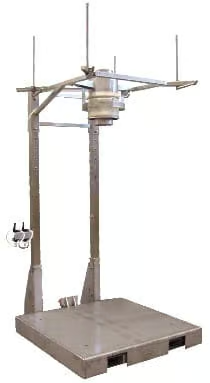
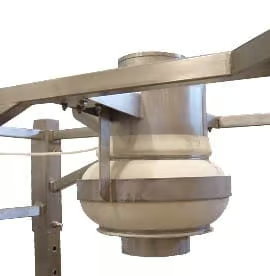
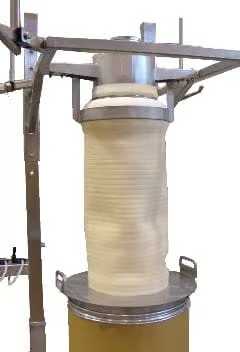
The support frame holds the bag in position while the inlet spout connects to the filling head. An inflatable seal closes the connection around the spout, and a vent path lets displaced air leave the bag.
Bag dimensions, loop spacing, spout length, and pallet height all influence the arrangement. These details matter as much as the target fill weight.
Simple filling. Integrated into the process.
The filling station can remain straightforward even when the surrounding process includes conveying, receiving, or mixing equipment.
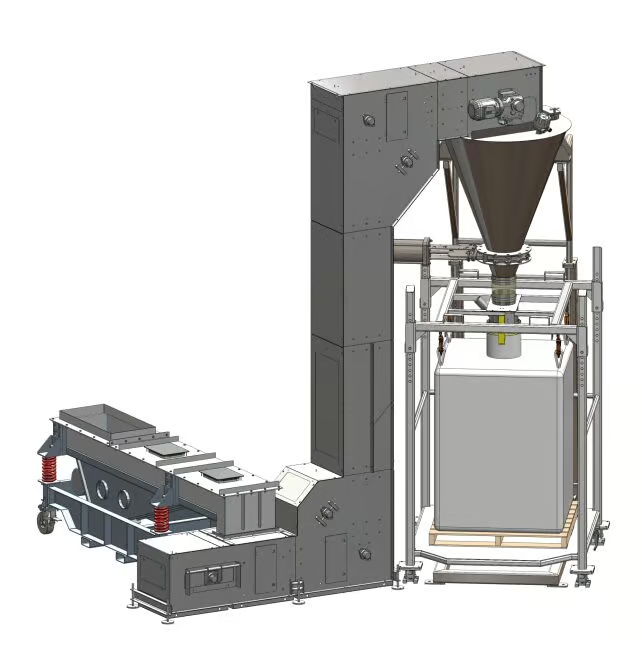
Bring product up to the filling point.
This rendering shows a low-level feeding arrangement, an elevating conveyor, and a receiving hopper positioned above the bulk bag filler.
The layout illustrates how a simple filling point can be incorporated where the product source and bag inlet are at different elevations.
Key planning questions: inlet location, transfer rate, hopper capacity, total height, and access for bag removal.
PDF illustration; no dimensional or performance specifications are shown.
Refill bulk bags after mixing.
Two bulk bag unloading stations feed a central mixer through inclined conveyors. A filling position beneath the mixer receives the blended material in a new bulk bag.
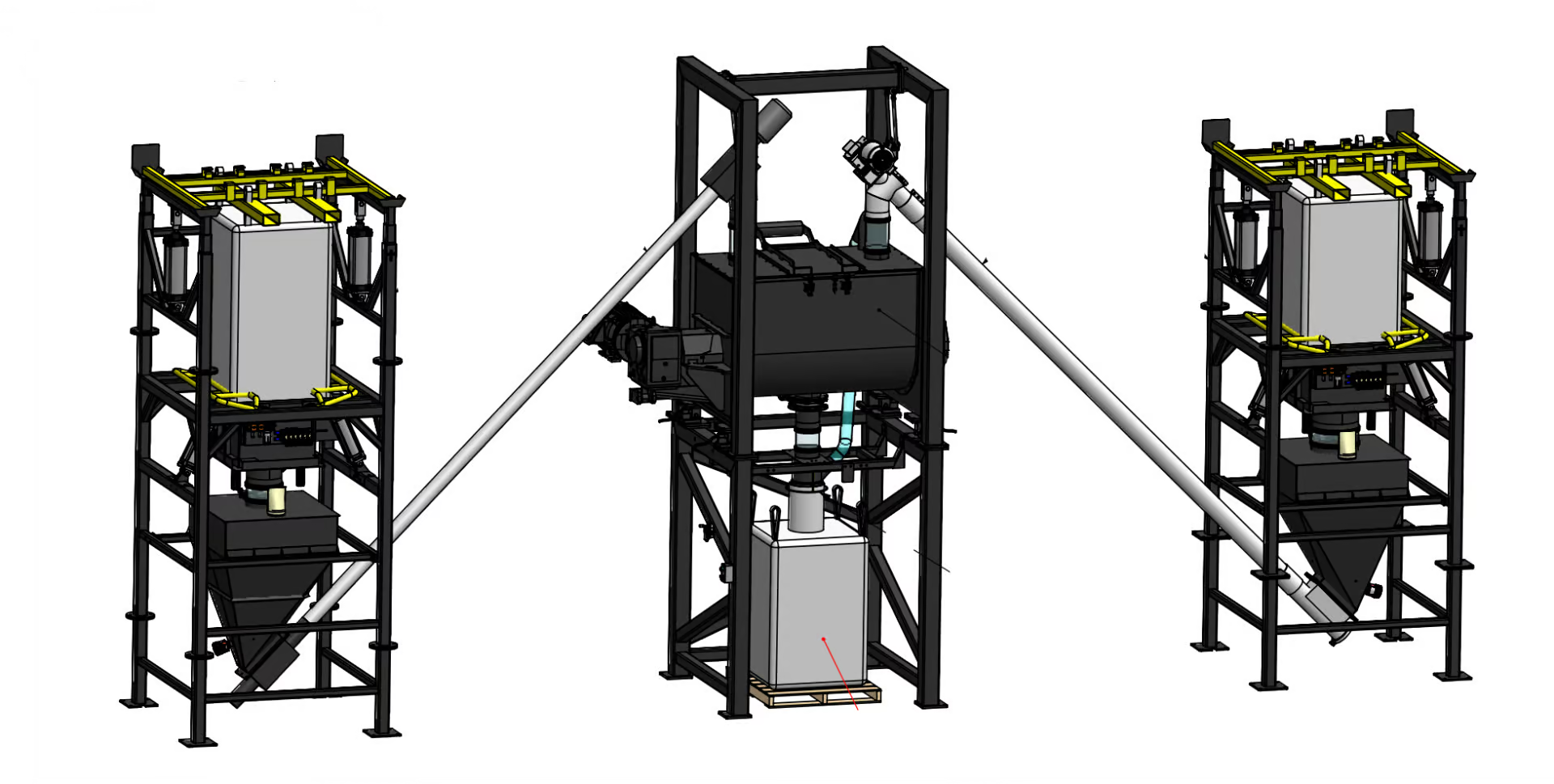
Design the sequence together: ingredient delivery, mixer batch size, discharge rate, bag capacity, and changeover access all shape the final layout.
These examples illustrate system arrangements. Equipment selection, dimensions, controls, and performance are defined for each project.
Options to discuss for your application.
| Function | Configuration to discuss | Why it matters |
|---|---|---|
| Weighing & control | Platform scale or load cells, indicator, and selected batch controls. | Match the fill to a target weight and define operator versus automatic cut-off. |
| Settling / densification | Vibratory platform or other application-suitable settling arrangement. | Evaluate how aerated material settles and how much usable volume the bag requires. |
| Bag inflation | Pre-inflation equipment where appropriate. | Help open the empty bag before product enters. |
| Construction | Mild steel or stainless steel; product-contact requirements. | Address environment, material compatibility, and cleaning practices. |
| Container flexibility | Drum or other container adapter where suitable. | Use one filling location for more than one approved container format. |
| Integration | Gravity supply, feeder, dust collection, and selected controls. | Connect the filling point to the existing production process. |
Confirm load rating, bag range, inlet dimensions, utilities, and required weight performance in the quotation. They are not universal specifications across all simple fillers.
Plan for the whole cycle.
- Position & attachPosition the bag and pallet as specified, attach the loops, and connect the inlet spout.
- Prepare & fillEstablish the fill connection, venting, and any selected weighing or inflation functions before introducing material.
- Finish & removeStop filling, complete any settling step, and follow the specified disconnection, closure, and removal sequence.
Before requesting a quote
Send your material, bag and pallet dimensions, target weight, required bags per shift, and available headroom. A photo of the current product outlet helps define the integration.
Also identify who handles bag closure and where the filled pallet goes. Those tasks can take as much planning as the fill itself.
Discuss My Simple FillerIf repeated bag transfers are the bottleneck, compare semi-automatic filling.
Simple bulk bag filler FAQs
Does “simple” mean I cannot automate the fill weight?
No. “Simple” describes the general bag-handling approach. A station can include weighing and controls that signal a suitable feeder or valve to stop. Define those functions explicitly in the quotation.
Can the same station fill different bag sizes?
An adjustable frame and support arrangement can accommodate a defined range. Provide the smallest and largest bags, including loop and spout details, so the required adjustments can be checked.
Can I use the station for drums?
A suitable drum-filling adapter can be included for compatible applications. Confirm container dimensions, connection details, weighing requirements, and how displaced air will be handled.
Will I need a dust collector?
The filling arrangement needs a suitable route for air displaced by the incoming product. The appropriate venting or collection method depends on the material, dust characteristics, fill rate, and facility requirements.
Can a simple filler work below a mixer or hopper?
Yes, where the layout and operating requirements allow. Review outlet elevation, flow control, bag access, and the relationship between batch size and usable bag capacity. The system examples above illustrate two possible arrangements.
Let’s configure your filling station.
Send us your material and bag details, production target, and a photo or layout. We can review a standalone station or its place in a larger process.